Guide
Parallel and perpendicular lines
Parallel lines have the same gradient, so they never cross. Perpendicular lines cross at a right angle, and their gradients multiply to -1. Here is how to check both from y = mx + c, and how to use the rule when you have to find a line yourself.
Two straight lines in the same coordinate system either cross each other or run alongside each other without ever meeting. If we write both lines as , the gradients tell us which of the two it is, and whether the crossing happens at a right angle.
When do I use this?
When a question gives you the equations of two lines and asks whether they're parallel or perpendicular, or when you have to write the equation of a line that must be parallel or perpendicular to another one. Everything here rests on what the gradient means, which you can read about in gradient and y-intercept, and it belongs to coordinate geometry.
Parallel lines: the same gradient
The gradient of a linear function shows how much we go up the y-axis when we go along the x-axis. So if two lines go in the same direction, they must also have the same gradient. That's what parallel lines are: two lines with the same gradient. Take
Both go up for every along, so they run alongside each other and never cross. The only difference between them is where they cross the y-axis.
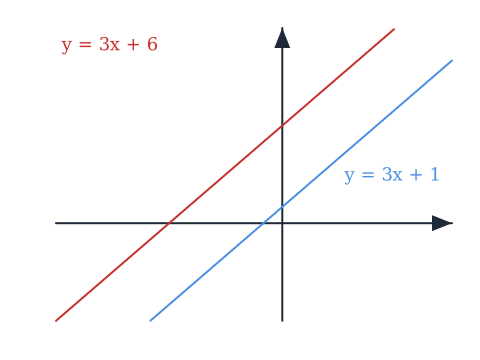
If the gradients are different, the lines cross exactly once, and we can find where. Say we have and . We set the two functions equal to each other, which we're only allowed to do because both of them equal :
Solving this gives . That's the x-coordinate of the crossing point. To find the y-coordinate we put into one of the functions, and it doesn't matter which one:
So the two lines cross at . If we draw them in a coordinate system, we can see that it fits. Two parallel lines never give us a crossing point like this.
Perpendicular lines: gradients that multiply to -1
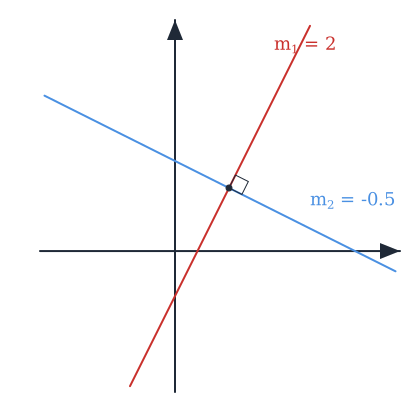
First, what are perpendicular lines? In my Danish notes they're called orthogonal lines, and orthogonal is just a smart word for right-angled. It means the two lines stand at right angles to each other, so they make an angle of . There's a rule, a kind of formula, that tells us something about two lines when they're perpendicular. It says that when two lines are perpendicular, the product of their gradients is :
Here is the gradient of one line and is the gradient of the other. The rule really just says: if you have two lines and multiply their gradients together, you can see whether they're perpendicular. If it gives , they are.
Let's take an example. We're given two lines,
and want to find out whether they're perpendicular. We use the rule, put in the two gradients and work it out:
Since it gives and not , the lines are not perpendicular. The two lines on the figure, on the other hand, have gradients and , and , so those two really are perpendicular.
Using the rule as a condition
We often use the rule as a kind of condition when we solve problems. It could be a task where we have to find the equation of a line that we know must be perpendicular to another line. Then we also know that the two gradients have to satisfy the rule: their product must be .
Say a line has gradient , and we want a line perpendicular to it. Its gradient has to satisfy
so . Any line with gradient is perpendicular to our line. If we're also given a point the new line has to pass through, we can write its equation with from the coordinate geometry glossary.
Where does the rule come from? In the book it's derived with vectors, which is beyond GCSE, so here we just use it.
Common mistakes
- "The gradients only need opposite signs." No. and have opposite signs, but , so those lines aren't perpendicular. The product has to be exactly .
- "Parallel lines have the same ." It's the gradient they share. and are parallel and cross the y-axis in different places.
- Setting two lines equal without checking they're both . We're only allowed to write because both sides equal . If one of the lines is written differently, get it into that form first.
Related
Frequently asked questions
Read next
Want to get good at maths?
Mathara explains every topic step by step with videos, exercises and personal feedback.
👉 Get started for free