Maths dictionary
Coordinate geometry: lines, distances and circles
Coordinate geometry is about describing figures like lines and circles with equations and coordinates. Here is the line through a point with a given gradient, the distance and midpoint between two points, parallel and perpendicular lines, and the equation of a circle.
Coordinate geometry is really about how we can describe geometric figures in a coordinate system. So: how do we describe things like circles and lines with equations and coordinates? Things get a lot easier once we have a precise description of their properties, and that's exactly what an equation gives us. If we can describe a circle with an equation, we know exactly how big it is, where it sits and what its radius is. All the information we need about a figure, we can put into an equation for that figure.
A lot of what you learn in coordinate geometry is just a collection of useful formulas. Here we'll also look at where most of the formulas come from, because they're a lot easier to trust once you've seen that.
The equation of a line through a point
We're used to describing a straight line with the equation of a linear function, . Now we're going to learn another way to describe a line. There are actually several, but what they all have in common is that they describe a line. They just do it using different information. That's why we have more than one: so we can describe the line whichever information we happen to have.
The first one comes from the gradient formula and looks like this:
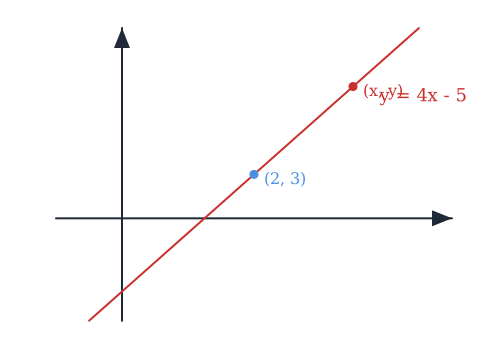
Here the line is described with the help of two points. One point has the coordinates . That's a point we actually have. It could be , say. The other point, , is not a point we have. We call it a running point. That just means it could be any point at all on the line, we just don't get told which one.
So to describe a line with this equation, we need the gradient and one point on the line. Let's take an example. If we have a line with gradient and the point , we can set up the equation:
We can actually simplify a bit by multiplying into the bracket:
And simplify a bit more by adding the numbers together:
So we actually end up with a linear function, just as we're used to.
In my Danish notes the gradient is called . In the UK we call it . It's the same number.
Why does the equation look like that?
Let's look at where it comes from. We start with the gradient formula that we know from straight lines:
If we multiply the denominator across, so we multiply over to the other side of the equals sign, we get
Remember that it's the whole denominator we multiply across, which is why the brackets appear. Now we add over to the other side:
As you can see, it's actually just a rewrite of the gradient formula. There's only one small difference. The gradient formula has two points in it, but here isn't a point we actually have. It's the running point, which means it can be any point that lies on the line.
Distance and midpoint between two points
When we have two points in a coordinate system, we can find the distance between them. We write the distance between and with two vertical bars, , meaning the length of the line segment from to :
You might already see that this looks a lot like Pythagoras' theorem, and that's because it comes straight from it. We can also find the point exactly halfway between and , the midpoint, by taking a kind of average of the two x-coordinates and of the two y-coordinates:
Both formulas, with worked examples and the Pythagoras picture behind the distance formula, are in the guide midpoint and distance between two points.
Parallel and perpendicular lines
The gradient tells us how much we go up the y-axis when we go along the x-axis. So two lines that go in the same direction must have the same gradient. Those are parallel lines. Lines that cross at a right angle are called perpendicular lines (the books use the smart word orthogonal, which just means right-angled), and for those there's a rule: the product of their gradients is ,
The guide parallel and perpendicular lines shows how to use both.
The equation of a circle
A circle can also be described with an equation. When we draw a circle in a coordinate system, there are three important things: the centre of the circle, the radius, and a point on the circle itself. With the centre at and radius , the equation is
Again is a running point, any point on the circle. What the equation really says is that every point on the circle is the same distance from the centre. At GCSE the centre sits at the origin, and then the equation is simply . The guide the equation of a circle goes through where it comes from and how to read the centre and radius off an equation.
Common misunderstandings
- "The in the equation is one particular point." No. is the running point: any point on the line or circle. The point we actually know is the one with the little zeros, , or the centre for a circle.
- "A line's equation always has to start with ." Not necessarily. describes the line using a point and a gradient, and you only get to after simplifying. Several forms, one line.
- "These formulas are just things to memorise." They come from things you already know. The line equation is the gradient formula rewritten, and both the distance formula and the circle equation are Pythagoras' theorem in a coordinate system.
Related guides
Guides on this topic
Midpoint and distance between two points
The distance between two points is the hypotenuse of a right-angled triangle, so the distance formula is just Pythagoras. The midpoint is a kind of average of the coordinates. Both, worked through step by step.
Parallel and perpendicular lines
Parallel lines have the same gradient, so they never cross. Perpendicular lines cross at a right angle, and their gradients multiply to -1. Here is how to check both from y = mx + c, and how to use the rule when you have to find a line yourself.
The equation of a circle
A circle is all the points that sit the same distance, the radius, from the centre. Put that into Pythagoras and you get the equation of a circle. Here is where it comes from, the GCSE case with the centre at the origin, and how to read the centre and radius off an equation.
Frequently asked questions
Read next
Want to get good at maths?
Mathara explains every topic step by step with videos, exercises and personal feedback.
👉 Get started for free