Maths dictionary
Pythagoras' theorem
Pythagoras' theorem is a kind of formula that says how the side lengths in a right-angled triangle are related. Here is what a² + b² = c² means, with the sides named and one worked example.
Pythagoras' theorem is a kind of formula that says something about how the side lengths in a right-angled triangle are related to each other. In a right-angled triangle we have, of course, three side lengths:
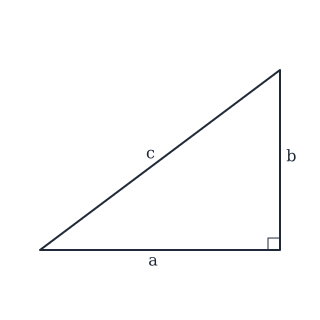
We typically call the sides , and . That is the whole setup. Three sides, one right angle, and a formula that ties the three lengths together.
The two shorter sides and the hypotenuse
The three sides have names. The two sides ( and ) that sit closest to the right angle are the shorter sides of the triangle, and the long side, the one that sits opposite the right angle, is what we call the hypotenuse.
It is worth getting that last part exactly right. The hypotenuse is the side opposite the right angle. It happens to be the longest side as well, but the way you find it in a drawing is to look at the right angle and then look across the triangle to the side that does not touch it.
What the theorem says
Pythagoras' theorem then says that if we take the length of one shorter side squared () and add the length of the other shorter side squared (), that gives us the length of the hypotenuse squared (). It looks like this:
Squared just means the number multiplied by itself. squared is the same as . (If squares and square roots do not quite make sense yet, it is a good idea to read about indices and roots first.)
So we can use Pythagoras' theorem to find one of the side lengths in a right-angled triangle, if we have the other two. That is what the theorem is for. It is not a deep fact to admire, it is a tool: two sides in, the third side out.
An example
Let's take an example:
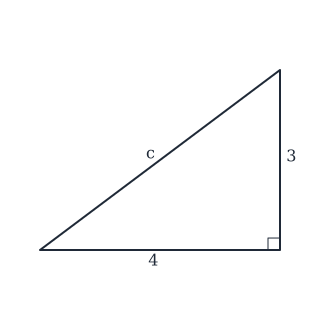
Here we have a right-angled triangle where one shorter side is and the other is . But what is ?
Here we can use Pythagoras' theorem. All we have to do is insert our values in the formula:
squared is, after all, the same as , which is , and squared is just , which is . So:
plus is :
Here we need to pay attention to something. We have got to be , and not just . So we have to remove this squared, because we want and not . We do that by taking the square root, and we have to remember to do it on both sides:
Now we just have to work out the square root of , which is . So:
So the hypotenuse, the last side length in the triangle, is . The full walkthrough of this kind of problem is in the guide on finding the hypotenuse.
When you need a shorter side instead
Sometimes we are not asked to find , but or instead. The formula is built to find , because stands alone on one side. So we have to move things around a bit so it is that stands alone.
If we look at the formula as an equation, we can get on its own by simply subtracting on both sides:
Smart, isn't it? Suddenly we have Pythagoras' theorem again, just rearranged for instead. All we did was get on its own, exactly like we get on its own in an equation. From here it is the same as before: insert the values, and take the square root at the end. That version gets its own guide about finding a shorter side.
Common misunderstandings
Pythagoras' theorem is short, so the mistakes people make with it are short too. They are almost always one of these:
- "The hypotenuse is just the longest side." It is the longest side, but that is not how you should find it. The hypotenuse is the side that sits opposite the right angle. Look at the right angle first, then across the triangle.
- "I can use Pythagoras' theorem on any triangle." No. It only works in right-angled triangles. That is why there is a right angle drawn in every figure here. For other triangles we use the sine rule and the cosine rule from trigonometry.
- "I got 25, so c is 25." No. The formula gives you . When , you still have to take the square root to get itself, which is . This is the step people most often forget, so it is worth slowing down at exactly that line.
- "Why is everything squared?" Because that is what the theorem says: it is the squared lengths that add up, not the lengths themselves. is , but the hypotenuse is . If the squaring itself feels unclear, read about indices and roots and come back.
Related guides
- Pythagoras' theorem: finding the hypotenuse
- Pythagoras' theorem: finding a shorter side
- Trigonometry: sine, cosine and tangent, for the triangles that do not have a right angle
Guides on this topic
Pythagoras' theorem: finding a shorter side
Sometimes you know the hypotenuse and one shorter side, and it is the other shorter side you are missing. Then you rearrange Pythagoras' theorem for it first, exactly like getting x on its own in an equation.
Pythagoras' theorem: finding the hypotenuse
When you know the two shorter sides of a right-angled triangle, Pythagoras' theorem gives you the hypotenuse. Insert the values, add the squares, and remember the square root at the end.
Frequently asked questions
Read next
Want to get good at maths?
Mathara explains every topic step by step with videos, exercises and personal feedback.
👉 Get started for free