Maths dictionary
What are indices (powers) and roots?
A power has two parts, a base and an index, and the index just tells you how many times to multiply the base by itself. Roots run the same thing backwards. Here is the short explanation with examples.
A power is made of 2 parts. The small raised number is called the index, and it tells us how many times the big number, which we call the base, has to be multiplied by itself.
That one sentence is the whole idea. In the UK you'll hear the small number called the index (plural indices), the power, or the exponent. They all mean the same thing, and the exam mostly says indices. What matters is that you read the small number as an instruction, not as decoration: it says "multiply the base by itself this many times".
The two parts of a power
We write the base as a big letter or number, and the index as a small raised one:
Here is the base, and is the index. The brace just says that there are copies of being multiplied together. That is all a power is: a compressed way of writing a long multiplication.
What the index tells you
So if we had a power called , the 4 would have to be multiplied together 2 times:
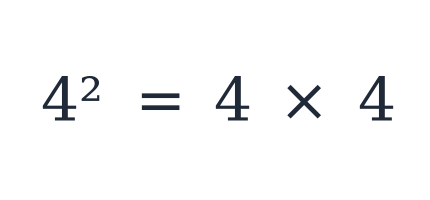
Another example could be , where 2 has to be multiplied together 5 times:
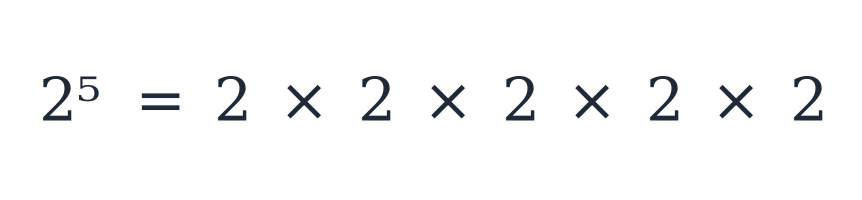
It's worth actually counting the 2s. There are five of them, and that's exactly what the index promised. Once you trust that, the notation stops being mysterious.
The laws of indices
Because a power is just repeated multiplication, powers with the same base follow a small set of rules. There are only a handful of them:
The last five come with the small print (and ), because you can't divide by zero. That's the complete list, and it's quietly reassuring that there are so few. Each rule gets a worked example in the guide on the laws of indices.
When the index isn't a positive whole number
Both examples above had whole positive numbers as the index. But what if the index were ? Then we'd have to multiply the base together times? Or what if the index were 0? That sounds mysterious with the definition of a power we have right now. So we have to extend our idea of a power a little.
The trick is that we don't invent new meanings. We keep the rules above and ask what and would have to mean for the rules to keep working. The answer for zero is that , and the answer for a negative index is a fraction: . And an index of turns out to be a square root. The whole argument is in the guide on zero, negative and fractional indices.
Roots are the opposite of powers
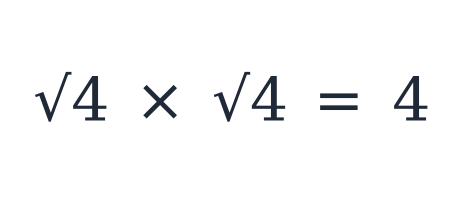
When we talk about roots, the square root is probably the one you think of first. The square root of a number is the number you have to multiply together 2 times to get it. So to find the square root of 4, we're looking for the number that gives 4 when multiplied by itself. There's no method for finding that number, it's really just guesswork (which is why the calculator has a button for it). But we know that , so the square root of 4 is 2:
The same concept applies to all the other roots. The cube root is the number that has to be multiplied together 3 times, the 4th root 4 times, and so on. We show which root it is with a small raised number in front of the root sign, so the cube root of 27 is , because .
Powers and roots are actually each other's opposites, just like multiplying and dividing are each other's opposites. This gets used a lot when solving equations, because they cancel each other out. If we have squared, we can take the square root to remove the power:
The full walkthrough, including cube roots and the rules for roots, is in the guide on square roots and cube roots.
Roots are powers too
Here is the neat part. We saw that an index of means a number that gives when multiplied by itself. That is exactly what a square root is, so
And this actually holds for every root:
So roots aren't a separate subject. They're powers with a fraction as the index, and every rule we have for powers works for them too. That's also what lets us simplify a surd like into , which has its own guide on simplifying surds.
One root, but two solutions
When we solved we got . But there's actually one more number that works: if we put in, we get as well, because negative times negative gives positive. So the equation has two solutions, 5 and .
So you might be thinking: doesn't that mean the square root of 25 also has two answers? No. When we take a square root, only the positive answer counts:
But when we solve equations that involve square roots, we get two solutions. Keep those two situations apart and this never trips you up.
Common misunderstandings
- " means times ." No. It means multiplied by itself times. is , not .
- " is 0." It's 1. The division rule forces it: , and a number divided by itself is 1.
- "A negative index gives a negative number." A negative index gives a fraction. , which is positive when is.
- "." The square root is 5. The only turns up when we solve the equation .
- "There must be a method for working out square roots." There isn't one you're expected to know. For anything that isn't a nice square number, it's guesswork or the calculator.
- "Roots and indices are two different topics." They're the same thing seen from two sides: .
Related guides
Guides on this topic
Simplifying surds
A surd is a root that doesn't come out as a whole number. We can't write it as a neat number, but we can often write it more neatly, using one rule for roots and a square number that divides in.
Square roots and cube roots
The square root of a number is the number you multiply by itself to get it, and the cube root is the same idea three times over. Roots are the opposite of powers, which is exactly why they're so useful in equations.
The laws of indices
There are only a handful of rules for working with powers, and every one of them falls straight out of what a power means. Here is the full list, why each rule works, and worked examples with numbers and letters.
Zero, negative and fractional indices
Multiply a number by itself zero times, or minus two times, or half a time? It sounds odd, but the laws of indices tell us exactly what those powers have to mean. Here is the argument and the worked examples.
Frequently asked questions
Read next
Want to get good at maths?
Mathara explains every topic step by step with videos, exercises and personal feedback.
👉 Get started for free