Maths dictionary
What is an equation?
An equation is a way we can find unknown values. The equals sign says both sides are exactly the same, like a scale in balance, and solving means doing the opposite on both sides until x stands alone.
An equation is a way we can find unknown values. Say you buy an apple and a banana that together cost 30p, and the banana cost 10p. So how much does the apple cost? We have an unknown price for the apple, but we know the total price and the price of the banana. We can write that as
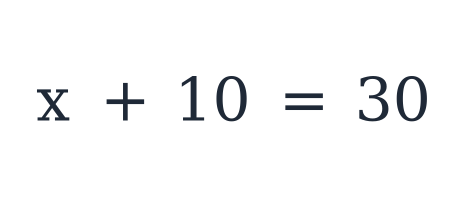
where is the price of the apple. That is an equation.
The equals sign says both sides are the same
An equation has an unknown value in it, and an equals sign. It's important to know that the equals sign means that what stands on both sides is exactly the same. So we're saying that has to be the same as . In other words, we have to find the number that gives 30 when 10 is added to it.
That one is solved pretty quickly, because we can see that . But it isn't always this easy. That's why we use a few rules that make it easier to solve equations.
An equation is like a balance scale
Here it's a big advantage to think of an equation as a set of scales, the old kind with a pan on each side. We know the equals sign says that what stands on the two sides has to be the same. Exactly like a scale in balance.
If the scales are to stay level, we can take weight off and put weight on, but it has to be done on both sides. The same goes for an equation. The equals sign still has to hold, so what stands on the two sides has to stay the same.
Getting the unknown on its own: do the opposite on both sides
Since we're interested in finding , we want the equation to end up in the form
We get there by taking a bit off each side of the equals sign. Look at the equation from the start:
Here we'd like the gone, because then is on its own (on its own, as my Danish notes call it, meaning stands alone on one side). Then we know what equals. We can do that by taking 10 away, because , and then the is removed. We do it on both sides:
That tells us equals 20. What we've just done is the opposite of , which is . The same goes if is multiplied by a number: then we can divide, because dividing is the opposite of multiplying. Take
Here is multiplied by 2, so if we divide by 2 on both sides we get
and is just the same as , after all, so .
The whole idea of solving equations is to find the opposite of what you want to get rid of, so you can get the unknown value on its own. At GCSE these opposites are called inverse operations, but "the opposite of" is all you need to think. The step-by-step version is in the guide how to solve linear equations.
Terms: the building blocks of an equation
An equation is split up into terms, which are separated by plus and minus. Take
Here we see six terms: , , , , and . It's still important to remember that the number and its sign belong together, so the third term is really , not . Knowing where one term stops and the next begins is what lets us simplify an equation safely before we solve it. There's a whole guide on terms in an equation.
Equations with x on both sides
Some equations have both on the right-hand and the left-hand side of the equals sign. Then we want to gather all the numbers on one side and all the 's on the other. Which side the 's should be on depends entirely on what is smartest for that equation. The full worked example is in the guide equations with the unknown on both sides.
Solving an equation with a graph
We can also solve equations graphically. An equation like
can be split at the equals sign into two lines, and . When we draw them in a coordinate system, the -value of the point where they cross is the solution to the equation. If the two lines don't cross, there's simply no solution. See solving equations with a graph, and the straight-line graphs entry if lines are new to you.
Several unknowns: simultaneous equations
Sometimes we have to solve equations with several unknowns, so we have to find a value for both and . To solve those, we need just as many equations as we have unknowns. One equation with several unknowns can't be solved on its own; we can only guess at what the values might be. When we have several equations that have to be solved together like this, we call it a system of equations. At GCSE they're called simultaneous equations.
There are several methods. The one I like best is the substitution method, where we make an expression for one of the variables and put it into the other equation. The other is the elimination method, where we make the coefficients of one variable equal in both equations so it goes out with itself.
Rearranging formulae
A formula is an equation too, just with several letters in it. Rearranging a formula means making the letter we want the subject, with exactly the same moves: find what is in the way, and do the opposite on both sides. That's how the formula for the area of a circle becomes a formula for the radius. See rearranging formulae.
Common misunderstandings
Equations trip people up in a handful of predictable ways:
- "The equals sign means 'here comes the answer'." No. It says that what stands on both sides is exactly the same, like a scale in balance. Both sides are already equal; one of the numbers is just unknown.
- "You solve an equation by moving things across to the other side." What actually happens is that we do the opposite on both sides. is removed by on both sides, and then it looks as if the 10 has moved. Thinking of it as the opposite on both sides keeps the scale balanced.
- " is the same as ." No. The number and the sign belong together, so a term keeps its minus wherever it goes.
- "I can take 10 off one side and 5 off the other, as long as it looks tidier." No. Whatever we do, it has to be done on both sides, otherwise the scale tips.
- ", so I take 2 away." No. is multiplied by 2, and the opposite of multiplying by 2 is dividing by 2. That gives .
- "Solving with a graph gives a different kind of answer." It's the same solution. Solving graphically is just finding the -value of the crossing point between the two lines the equation makes.
- "Substitution and elimination give different answers." They give the same and . The answer belongs to the equations, not to the method you pick.
Related guides
Guides on this topic
Equations with the unknown on both sides
When x appears on both sides of the equals sign, we first simplify each side, then gather all the x's on one side and all the numbers on the other, and only then get x on its own.
How to solve linear equations
Solving an equation means getting x to stand alone. The trick is always the same: find what is in the way of x, do the opposite of it on both sides, and keep the scales balanced.
Rearranging formulae: changing the subject
Rearranging a formula means making the letter we want the subject, with the same moves we use for any equation. That is how the formula for the area of a circle becomes a formula for its radius.
Simultaneous equations: the elimination method
The elimination method makes the coefficients of one unknown equal in both equations, so that unknown goes out with itself and you are left with one ordinary equation to solve.
Simultaneous equations: the substitution method
Two equations with two unknowns can be solved by substitution: get one unknown on its own in one equation, put that expression into the other equation, and you are left with one ordinary equation to solve.
Solving equations with a graph
An equation can be solved with a graph. We split it at the equals sign into two lines, draw both, and the x-value of the point where they cross is the solution. If they never cross, there is no solution.
Terms in an equation: what is a term?
An equation is split up into terms, separated by plus and minus. Knowing where one term stops and the next begins, and that the sign belongs to the term, is what lets you simplify safely.
Frequently asked questions
Read next
Simplifying algebraic expressions: terms and like terms
DictionaryLinear functions and straight-line graphs (y = mx + c)
GuideHow to solve linear equations
GuideEquations with the unknown on both sides
GuideTerms in an equation: what is a term?
GuideSolving equations with a graph
GuideSimultaneous equations: the substitution method
GuideSimultaneous equations: the elimination method
GuideRearranging formulae: changing the subject
Want to get good at maths?
Mathara explains every topic step by step with videos, exercises and personal feedback.
👉 Get started for free