Guide
Solving equations with a graph
An equation can be solved with a graph. We split it at the equals sign into two lines, draw both, and the x-value of the point where they cross is the solution. If they never cross, there is no solution.
We can also solve equations graphically. Graphically means that we look at the equation as lines in a coordinate system, and read the solution off where the lines cross. The usual hurdle is reading off the wrong coordinate.
When do I use this?
When we solve an equation, we know that we have to find the -value (or values) that make the equation hold. When we solve an equation graphically, that corresponds to finding the -value of the crossing point between the two lines that the equation makes. It's useful when you want a quick picture of what's going on, and especially when you want to know whether the equation has a solution at all. If drawing a line from its equation is new to you, the guide on plotting a graph from an equation covers it.
The procedure
- Split the equation at the equals sign into two lines: the left-hand side, and the right-hand side.
- Draw both lines in the same coordinate system.
- Find the point where the two lines cross.
- The -value of that crossing point is the solution to the equation.
Worked example
Take the equation
This equation we can split into two lines, which are separated by the equals sign. Namely the lines
When we look at these two lines graphically, we get one or another crossing point. The -value of this crossing point is the solution to our equation.
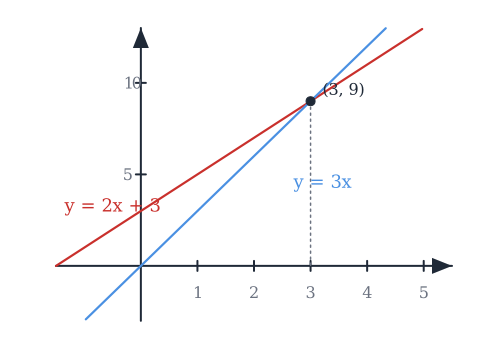
Here we can see that the -coordinate of the crossing point is 3, which means that the solution to this equation is 3. So:
We can check this is right, because we know both sides of the equation have to give the same number when we put 3 in: and . That's also why the crossing point sits at . Both lines are worth 9 there. The same equation solved algebraically, by taking away on both sides, is in the guide on equations with the unknown on both sides, and it gives too.
What if the lines don't cross?
If the two lines have no crossing point, what happens then? Well, then there is simply no solution to the equation. This graphical way of doing it makes it super easy to find out whether there is a solution to the equation or not.
Common mistakes
- "The lines cross at , so the solution is 9." The solution is the -value of the crossing point, so . The 9 is what both sides are worth when is 3.
- "Solving with a graph is a different thing from solving with algebra." It's the same solution. The graph just shows it as the place where the two lines meet. If you're unsure about lines in general, the straight-line graphs entry explains them.
- "If I can't find a crossing point, I've drawn it wrong." Maybe, but maybe not. If the two lines genuinely don't cross, the equation simply has no solution.
Related
Frequently asked questions
Read next
Want to get good at maths?
Mathara explains every topic step by step with videos, exercises and personal feedback.
👉 Get started for free