Guide
Equations with the unknown on both sides
When x appears on both sides of the equals sign, we first simplify each side, then gather all the x's on one side and all the numbers on the other, and only then get x on its own.
Some equations have both on the right-hand and the left-hand side of the equals sign. Then we want to gather all the numbers on one side and all the 's on the other, and only then get on its own. The usual hurdle is not the gathering itself but a stray minus sign that gets lost on the way.
When do I use this?
Whenever shows up on both sides, like here:
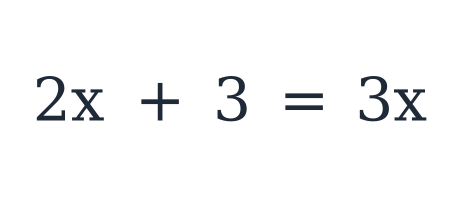
Everything from the basic guide on how to solve linear equations still holds: the equals sign says both sides are exactly the same, and whatever we do, we do on both sides. We just have one extra job first: getting the 's together.
The procedure
- Simplify each side first. See whether there is anything we can multiply, add or take away on each side, so that each side is as short as possible. Remember that the sign belongs to what stands right after it. This is the same move as in the guide on simplifying both sides of an equation.
- Gather the 's on one side and the numbers on the other. We do that by doing the opposite of an -term on both sides, exactly as we would with a number. Which side the 's should be on depends entirely on what is smartest for that equation.
- Get on its own. Do the opposite of what is left in the way, on both sides, until stands alone.
Worked examples
Example 1: a long one
Let's take an equation with a few more terms in it:
The first thing we do with an equation like this is to see whether we can simplify anything. Is there anything we can multiply already, or add, or take away? It's important to remember that the signs belong to what stands right after them. So when it says
that is minus times 4, so we end up with , and not just . That's important to remember.
Let's start simplifying. We can see that becomes :
and that becomes . It becomes that because we have two times, which is , after all:
Now we can see that we have both negative and positive 's on both sides, which we can take away from each other. On the left-hand side we have both and . If we add and then take away, that gives 0, so they go out with each other. So they disappear:
On the right-hand side we have and , which we can add together to get :
Now that we've simplified, we can begin to get on its own. We can see that stands in the way, so we'd like it removed. We do that by taking 12 away on both sides. So we do the opposite of (which is ), and it disappears:
We can see that is multiplied by 2, because there is always a hidden multiplication sign between a number and a letter. We'd like that gone, so comes to stand alone. So we do the opposite of "times 2", which is "divide by 2". We divide by 2 on both sides, so we can get alone:
So we've arrived at being equal to 15.
Example 2: taking an x-term away on both sides
In the first example the 's on the left went out with each other by themselves. Usually we have to do a bit more. Take
There is nothing to simplify on either side, so we go straight to gathering the 's. The smartest side here is the right, because is bigger than , so we won't end up with a minus in front of . To get rid of the on the left we do the opposite of , which is , on both sides:
So is 3. We can check this is right, because we know both sides have to give the same number: and . This is also the equation we solve with a graph in solving equations with a graph, and the two lines cross exactly at .
Common mistakes
- " is ." No. The sign belongs to what stands right after it, so is . Dropping the minus changes the whole equation.
- "I took away from the left side, so the left is done." Whatever we do has to be done on both sides. becomes , not .
- "Now is on the right, so something went wrong." Nothing went wrong. says exactly the same as . Which side the 's end up on is just a matter of what is smartest for the equation.
- "I'll start rearranging before I simplify." You can, but it gets messy. The first thing to do is to see whether there is anything to simplify. Then the equation is short, and the rearranging is the easy part.
Related
Frequently asked questions
Read next
Want to get good at maths?
Mathara explains every topic step by step with videos, exercises and personal feedback.
👉 Get started for free