Guide
How to solve linear equations
Solving an equation means getting x to stand alone. The trick is always the same: find what is in the way of x, do the opposite of it on both sides, and keep the scales balanced.
Solving an equation means finding the unknown value, most often called . The trick is always the same: find what is in the way of , do the opposite of it, and do it on both sides of the equals sign. The usual hurdle is remembering that "both sides" is not optional.
When do I use this?
Whenever a letter stands for a number you don't know, and an equals sign tells you how it relates to numbers you do know. If you're not sure what an equation actually is, read that entry first; it explains why an equation behaves like a scale in balance. The equals sign says that what stands on both sides is exactly the same, and everything below follows from that.
The procedure: keep the scales balanced
Since we're interested in finding , we want the equation to have the form
We get there by taking a bit off each side of the equals sign, one step at a time:
- Look at what stands next to and is in the way. Is a number added? Is multiplied by a number?
- Do the opposite of it. The opposite of is . The opposite of multiplying by 2 is dividing by 2.
- Do that opposite on both sides of the equals sign, so the scales stay level.
- Repeat until stands alone on one side, and then we know what is.
The whole idea of solving equations is to find the opposite of what you want to get rid of, so you can get the unknown value on its own.
Worked examples
Example 1: a number is added
Here we'd like the gone, because then is on its own. We can do that by taking 10 away, since , and then the is removed. We do it on both sides:
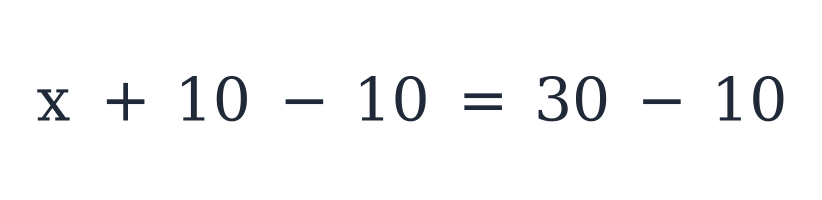
So equals 20. We can check this is right, because we know that . What we did was the opposite of , which is .
Example 2: x is multiplied by a number
The same goes if is multiplied by a number: then we can divide, because dividing is the opposite of multiplying. Take
In this example is multiplied by 2, so if we divide by 2 on both sides we get
is just the same as , after all, so
Example 3: two steps
Often both things are in the way at once:
We can see that stands in the way, so we'd like it removed. We do that by taking 12 away on both sides. So we do the opposite of (which is ), and it disappears:
Now we can see that is multiplied by 2, because there is always a hidden multiplication sign between a number and a letter. We'd like that gone too, so comes to stand alone. So we do the opposite of "times 2", which is "divide by 2". We divide by 2 on both sides:
So we've arrived at being equal to 15. It doesn't matter that ended up on the right: says exactly the same as .
When we solve equations, we always do the same thing on both sides, because we want to get the equation down to "". Some equations have on both the right-hand and the left-hand side of the equals sign. Then we first gather all the numbers on one side and all the 's on the other; that gets its own guide, equations with the unknown on both sides.
Common mistakes
- "I took 10 away on the left, so the left is done." Whatever we do has to be done on both sides, otherwise the scale tips. becomes , not .
- ", so I take 2 away and get ." No. is multiplied by 2, and the opposite of multiplying is dividing. gives .
- " is , and that is not the same as ." It is. is just ; the 1 in front doesn't change anything.
- " is wrong because should be on the left." It's the same statement either way round. The equals sign says both sides are the same, in whichever order you write them.
Related
Frequently asked questions
Read next
Want to get good at maths?
Mathara explains every topic step by step with videos, exercises and personal feedback.
👉 Get started for free