Guide
Simplifying both sides of an equation before you solve it
Simplifying is a good tool for getting an overview of the long equations we work with. Collect the x's on each side, then the numbers, and 2x + 45 × 2 − 2x + 3x = −4x + 5 × 2 − 3 + 3x collapses to 90 + 3x = 7 − x.
Simplifying is a good tool for getting an overview of the long equations we work with. We take each side of the equals sign on its own, collect the x's, collect the numbers, and the equation shrinks to something we can actually solve. The hurdle is keeping the x's and the numbers apart, and keeping every sign with its term.
When do I use this?
Whenever an equation looks longer than it needs to be. Take this one:
This equation can look really long and hard, but once we've simplified a bit, it's actually quite manageable. When you meet equations, functions or anything else where you can see that something can be simplified, it's always a good idea to do it. The actual solving comes afterwards, see how to solve linear equations.
The procedure
We still have to remember, while we simplify, that apples and bananas must not be mixed. Ordinary numbers and the x's must be kept apart. And we work on one side of the equals sign at a time.
1. Start with the x's on each side. In the book, the x-terms on the left are circled in red so you can see which ones belong together: , and . On the left side of the equation we can simplify those x's down to
Instead of all those x's, we can make do with just writing on the left side:
2. Now the x's on the right side.
and we get:
3. Then the numbers. On the left side we see that , and on the right side we have . So we end up with the equation
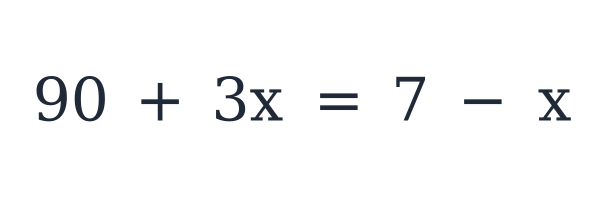
With just a little simplifying, the equation has gone from being long and confusing to suddenly being manageable and easy to solve.
The sign travels with the term
It's also important, when we simplify in equations, that the sign in front, the plus or minus sign, comes along when we simplify. With the example from before, look at the minus sign behind the first , the one in the middle of . In the book the second pass of the diagram circles the terms with their signs inside the circles: , and . It's really important that the minus comes along, because is not the same as . The sign, plus or minus, belongs to the letter or number it stands in front of.
That's also why and cancel out: one is plus 2 x's, the other is minus 2 x's, and together they're nothing.
Worked example
Simplify both sides of
Left side, the x's: . Left side, the numbers: . So the left side is .
Right side, the x's: . Right side, the numbers: . So the right side is .
We can check this is right, because we know that nothing has crossed the equals sign. Every term is still on the side it started on, we've only added up the ones that belong together. From here the equation is solved like any other, which is the job of the equations guides.
Common mistakes
- "Adding the x's to the numbers." and are apples and bananas. The x's are collected with the x's, the numbers with the numbers, and is as far as it goes.
- "Losing a minus on the way." When you gather the x's, stays . The sign belongs to the term. Drop it, and wrongly becomes instead of .
- "Mixing the two sides." Simplifying is done on each side of the equals sign separately. Nothing is moved across the equals sign while you simplify. Moving terms across is the next step, solving.
- "Thinking the result must be a single term on each side." and are fully simplified sides. Letters and numbers can't be combined further.
Related
The rule behind every step here is collecting like terms, and the idea of terms and signs is in simplifying expressions. What to do with next is in how to solve linear equations.
Frequently asked questions
Read next
Want to get good at maths?
Mathara explains every topic step by step with videos, exercises and personal feedback.
👉 Get started for free