Maths dictionary
Simplifying algebraic expressions: terms and like terms
Simplifying is a way of making maths easier to get an overview of. We work out as much as we can, but we're not allowed to add apples and bananas: 2a + 3a becomes 5a, and 2a + 5 has to stay as it is.
Simplifying is a way of making maths easier to get an overview of. If we need to simplify something like
we just work out as much as we can. In this little example we can add the two numbers together, , so it becomes
We actually can't work out any more than that, because we have 2 x's and a 6. We can't add those together, since the one is letters and the other is a number. This is what we call simplifying. We just make our calculations, equations, functions, or whatever else it might be, smaller.
How algebra is written
Before we go further, a word about how these expressions are written. means 2 times , which we could also write as . When a number and a letter are stuck together like , the multiplication is simply left out. In the same way means , and means . The letters stand in for numbers we don't know yet, and the whole point of simplifying is to tidy up an expression without knowing what those numbers are.
What is a term?
An expression is split into terms, and the terms are separated by plus and minus. In the expression
the terms are , , and . Notice that the minus sign in front of the middle is part of that term. The sign, plus or minus, belongs to the letter or number it stands in front of. It's really important that it comes along when we move things around, because is not the same as .
There's also an invisible plus. In we don't write a plus in front of the , and in we don't write one in front of , but it's there. Remembering the invisible plus is what keeps the signs right when we open brackets, which we come back to below.
Like terms: apples and bananas
When we simplify, it's important to remember that we're not allowed to add apples and bananas. If we had to simplify the expression
we're not allowed to add the 's and the 's together, because they're 2 different things. We can see, though, that there's both and . We're allowed to add those together, since they're both 's. So we can simplify this expression to
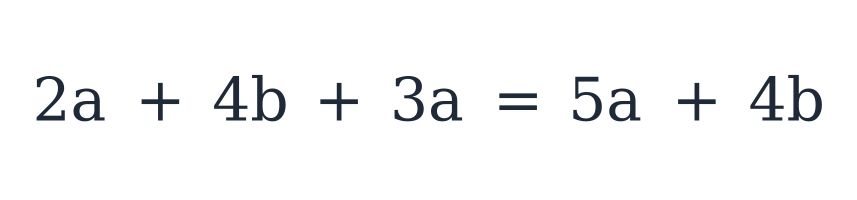
Exactly the same goes for numbers and letters. If we have an example like this one:
we can't make it any smaller, because we have 2 a's and a 5. We're not allowed to mix those together.
In the exam these are called like terms, the terms that are the same kind of thing. The apples-and-bananas picture is the whole rule: like with like, and nothing else. The most important thing to remember when we simplify is that letters and numbers must not be mixed. So we can easily end up with the answer to a simplifying question being something like
That's a perfectly finished answer. The step-by-step walkthrough is in the guide collecting like terms.
Simplifying inside an equation
Simplifying is a good tool for getting an overview of the long equations we work with. An equation like
can look really long and hard, but once we've simplified a bit, it's actually quite manageable. We still have to remember that apples and bananas can't be mixed, so the ordinary numbers and the x's are kept apart, and we simplify each side of the equals sign on its own. When we do that, the whole thing collapses to
With just a little simplifying, the equation has gone from being long and confusing to suddenly being manageable and easy to solve. Whenever you meet equations, functions or anything else where you can see that something can be simplified, it's always a good idea to do it. Every step of this example is in the guide simplifying both sides of an equation.
Brackets
Brackets sit at the top of the order of operations, and the sign in front of a bracket decides what kind of bracket it is, and so how we open it. With a multiplication in front, like , we have to multiply into the bracket, because can't be worked out as a single number. With a minus in front, like , we flip the signs of everything inside. Both moves are in the guide expanding a single bracket.
Two brackets multiplied together, like , are opened by multiplying everything in the one bracket with everything in the other, and then collecting like terms. That's the guide expanding double brackets.
Common misunderstandings
- "." No. That's adding apples and bananas. is 2 x's and is a number, and they can't be mixed. is already simplified.
- "When you've simplified, you should be left with a single term." Not necessarily. stays as , and an answer like is completely finished.
- "The sign can be dropped when you rearrange the terms." No. The sign in front belongs to the term. is not the same as , so the minus has to travel with it.
- "Simplifying changes the expression." It doesn't change the value. and are the same thing written two ways, and the same goes for both sides of an equation.
- "Simplifying is only for small expressions." It's actually most useful on the long, scary ones. That's exactly where a little simplifying turns something confusing into something you can solve.
Related guides
Guides on this topic
Collecting like terms
Collecting like terms is how we simplify an expression: we add together the terms that are the same kind of thing and leave the rest alone. 2a + 4b + 3a becomes 5a + 4b, and 2a + 5 stays exactly as it is.
Expanding a single bracket
The sign in front of a bracket decides how we open it. A multiplication in front means we multiply into the bracket, so 3 × (2x + 3y) = 6x + 9y. A minus in front means we flip the signs of everything inside.
Expanding double brackets
Two brackets multiplied together are opened by multiplying everything in the one bracket with everything in the other. (x + 1)(x − 2) gives x² − 2x + x − 2, which simplifies to x² − x − 2.
Simplifying both sides of an equation before you solve it
Simplifying is a good tool for getting an overview of the long equations we work with. Collect the x's on each side, then the numbers, and 2x + 45 × 2 − 2x + 3x = −4x + 5 × 2 − 3 + 3x collapses to 90 + 3x = 7 − x.
Frequently asked questions
Read next
Want to get good at maths?
Mathara explains every topic step by step with videos, exercises and personal feedback.
👉 Get started for free