Guide
Expanding a single bracket
The sign in front of a bracket decides how we open it. A multiplication in front means we multiply into the bracket, so 3 × (2x + 3y) = 6x + 9y. A minus in front means we flip the signs of everything inside.
Brackets are the top step of the order of operations, so they're also what we deal with first when we work out a calculation or solve an equation. The sign in front of the bracket, , or , decides what kind of bracket it is, and so how we open it. (Opening a bracket just means working it out.) The typical hurdle is a bracket with letters inside, because then we can't simply work out what's in it.
When do I use this?
Whenever a bracket is in the way. In the exam this is called expanding the bracket, and there are three cases, depending on the sign in front.
With a plus in front, like
we can just work out what's inside the bracket. There's nothing special to take into account. With a multiplication or a minus in front we have to do it differently, and that's what this guide is about. Where brackets sit among the other operations is in order of operations.
Multiplication brackets: multiply into the bracket
A bracket with a multiplication sign in front, like this one:
Here we're forced to multiply into the bracket, which means we multiply 3 with both terms in the bracket. In the book there are two arrows from the 3, one to each term, and each arrow is a multiplication. So:
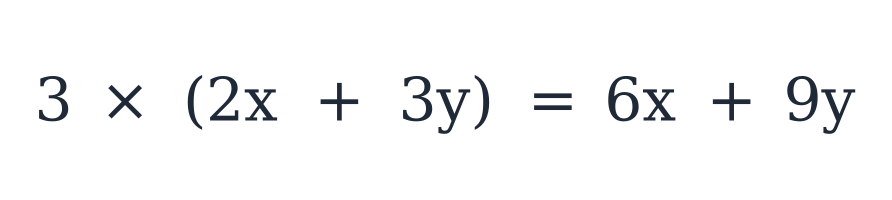
So when we can't work out what's inside the bracket, we have to multiply into it.
If there had only been numbers inside the bracket, like
we could easily have worked out the bracket first and then multiplied by 3. We'd add 2 and 3:
and then multiply:
If we had multiplied into the bracket instead, we would have said
We multiply 3 by 2, and then 3 by 3. It gives us the same result. So with only numbers inside, both ways work. It's when we can't work out or simplify what's inside the bracket that we're forced to multiply in.
Minus brackets: flip the signs
This is a minus bracket, because there's a minus in front. Here we could easily start by working out what's inside the bracket and then subtract it from 3. But when the bracket gets more complicated, we have to do it another way. We have to flip the signs, the plus and minus, on all the terms inside the bracket:
turns into , and turns into . Remember that there's also an invisible plus in front of . That's exactly why it becomes .
It can seem strange to flip the signs, but there's a good reason for it. A bracket, or anything else, can always be written with in front, since the bracket is there 1 time. So we can also write this example as
Here we can see that we have a multiplication bracket with . When we multiply into the bracket, we see that the signs inside the bracket simply flip:
So that's why we can just flip the signs when we open minus brackets.
Worked examples
A multiplication bracket with letters. Expand .
Multiply the 3 with both terms: and .
A multiplication bracket with only numbers. Work out .
Either way works. Inside first: . Multiplying in: .
A minus bracket. Expand .
Flip every sign inside: becomes , becomes .
We can check this is right, because we know a bracket can be written with in front, and multiplied into gives .
Common mistakes
- "Work out the inside of the bracket first, even when there are letters in it." You can't. isn't a single number, so there's nothing to work out. That's the whole reason we multiply into the bracket.
- "Forgetting the invisible plus." In there's an invisible in front of the . Flip it, and becomes . Forget it, and you'll leave the positive.
- "The sign flip is magic." It isn't. is , a multiplication bracket with , and multiplying in is what flips the signs.
- "Plus brackets need special treatment." They don't. is just .
Related
Brackets are the top of the pyramid in order of operations, and once a bracket is open you usually finish by collecting like terms. Two brackets multiplied together, like , follow the same idea one step further, see expanding double brackets. The overview lives in simplifying expressions.
Frequently asked questions
Read next
Want to get good at maths?
Mathara explains every topic step by step with videos, exercises and personal feedback.
👉 Get started for free