Maths dictionary
Order of operations (BIDMAS)
Before you can learn any maths, the basics have to be in place. The order of operations is a pyramid: brackets first, then powers and roots, then multiplying and dividing, and finally adding and subtracting.
Before you can learn any maths, it's important to have the basics under control. That's why the rules of calculation are among the first things we look at. If we don't have the most basic maths in place, it's really hard to build anything on top of it.
The most basic rule of all is the order of operations: when a calculation has several operations in it, which one do we do first? In the UK you'll know the answer as BIDMAS. It's the same thing as the pyramid below, just with a name.
The pyramid
The order of operations is a way for us to decide which terms get worked out first in all sorts of calculations and equations. It's set up as a pyramid with four levels, and the top level is done first:
- Brackets:
- Powers and roots: and
- Multiplying and dividing: and
- Adding and subtracting: and
The pyramid tells us to start with the brackets, then powers and roots, then multiplying and dividing, and finally plus and minus. That's the whole rule. Notice that multiplying and dividing share a level, and so do adding and subtracting. The levels are what matter, not the order within a level.
BIDMAS spells out the same pyramid letter by letter: Brackets, Indices (that's powers and roots, see what indices and roots are), Division and Multiplication, Addition and Subtraction. If you can picture the pyramid, you don't have to remember the letters.
A worked example
Let's take an example:
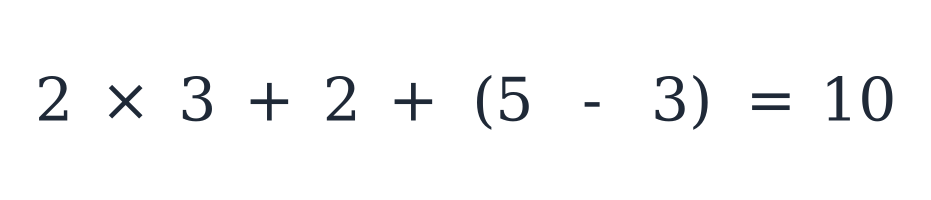
We start with the bracket. , so:
Then we multiply, since there are no powers or roots:
And finally we add up:
In this example we could actually have multiplied first, since the bracket and the multiplication term were independent of each other. They don't affect each other. But it's always best just to stick to the order of operations. The habit is what saves you when the parts do affect each other.
Brackets
Brackets are the top level of the pyramid, so they get priority when we work out calculations and solve equations. The sign in front of a bracket (, or ) decides what kind of bracket it is, and so also how we open it. Opening a bracket just means working it out.
A plus in front means we simply work out what's inside. A times in front means the number has to be multiplied into the bracket, onto every term inside. A minus in front means the signs inside the bracket flip. That last one surprises people, and there's a good reason for it, so the three kinds get their own guide on brackets in calculations. Brackets with letters inside, like , are handled in expanding a single bracket.
The operators
Operators are symbols that show that some particular process has to happen. That could be the four basic operators we have: plus, minus, times and divide (, , , ). Divide is written either with or as a fraction.
Operators can't do anything on their own. They have to act on some numbers (or functions), like . The plus by itself has no value without the numbers.
Here is a short list of the operators we meet, and what each one does:
- Plus (): we add 2 numbers together.
- Minus (): we subtract 2 numbers from each other.
- Times (): we add a number to itself several times.
- Divide (): we split a number into equally big parts.
- Root (): we find the number that, multiplied by itself times, gives .
- Power (): we multiply by itself times.
The last two are the second level of the pyramid, and they're each other's opposites, just like times and divide are. That's why roots undo powers when we solve equations. There's more on that in what indices and roots are.
Common misunderstandings
- "You can do the operations in any order." You can't. In the bracket comes first, then the multiplication, then the additions, and that is how we get 10. The pyramid decides, and when you want a different order you write brackets.
- "If the order doesn't matter in this particular sum, I can skip it." Sometimes the parts really are independent, like in the worked example above. It's still best to stick to the order every time, so it's automatic when it does matter.
- "A plus in front of a bracket needs special handling." It doesn't. You just work out what's inside. It's the minus and the times in front that change things.
Related guides
Guides on this topic
Frequently asked questions
Read next
Want to get good at maths?
Mathara explains every topic step by step with videos, exercises and personal feedback.
👉 Get started for free