Guide
Rearranging formulae: changing the subject
Rearranging a formula means making the letter we want the subject, with the same moves we use for any equation. That is how the formula for the area of a circle becomes a formula for its radius.
A formula is an equation with several letters in it, and rearranging it means making the letter we want the subject. When we rearrange a formula, we really just make the value we'd like to have the subject, so that it comes to stand alone. At GCSE this is called changing the subject. The usual hurdle is a letter that is squared, because that needs a square root to undo it.
When do I use this?
Whenever a formula gives you one thing, but you know the others. The formula for the area of a circle gives you the area from the radius, but sometimes you're given the area and need the radius. The formula for compound interest gives you the final amount, but sometimes you know the final amount and want to know what you started with. In both cases we rearrange the formula, with exactly the same moves as when we solve any equation. If rearranging things still feels hard, read how to solve linear equations first.
The procedure
- Decide which letter you want to stand alone.
- Look at what is in the way of it. Is it multiplied by something? Is something added? Is it squared?
- Do the opposite on both sides. Multiplying is undone by dividing, adding by taking away, and squaring by taking the square root.
- Keep going until the letter stands alone. What you have then is a new formula, for that letter.
Worked examples
Example 1: the radius of a circle from its area
If we look at the formula for the area of a circle, which is
we can see that we actually only have two unknown things: the area () and the radius (). That's because is a number we know (3.14...). So if we have to find the radius, we only need to know the area. In other words, if we're given the area in a task, we can find the radius. Let's look at an example.
We're told in a task that the area of a circle is 36. We now have to find the radius. We do that by putting 36 in 's place in the formula for the area:
Now we can see that we have an equation where we have to find , so the radius. Remember that is just a number. We get the radius on its own. We do that by first dividing by , so the radius can stand alone:
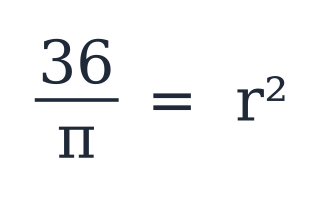
Now we can take the square root on both sides, to get on its own. We do that because we have squared, and we can remove that by taking the square root. Taking the root is the opposite of squaring, which is explained in the guide on square roots and cube roots.
Now we just type this into our calculator and get
It can seem a bit complicated, but in very many tasks it says that , and then it gets a bit easier. Then you just calculate with equal to 3 instead.
So we can just rearrange the formula for the area, so that it becomes a formula for the radius instead:
The same example, seen from the circle's side, is in finding the radius of a circle from its area.
Example 2: the starting amount in compound interest
The formula for compound interest is
where is the amount we start with, is the interest rate written as a decimal, is the number of periods, and is the amount we have after periods. If we have the values for , and and have to find , so the amount we started with, we have to make the subject of the formula. We have to shuffle our values around so that comes to stand alone. We start, of course, from the formula itself.
We can see that is multiplied by , so we can divide by on both sides, because then stands alone:
Now we've rearranged the formula, so we have a formula that can be used to find . The rate can be made the subject in the same spirit: divide by first, and then undo the power with a root, the same way we undid the square with a square root above.
Common mistakes
- "I divided the right-hand side by , so stands alone now." Whatever we do has to be done on both sides. becomes , with the 36 divided too.
- ", so the radius is ." That's squared, not . We still have to take the square root on both sides to get alone.
- " is a letter, so it's an unknown." is a number we know. In the area formula there are really only two unknowns, and .
Related
Frequently asked questions
Read next
Want to get good at maths?
Mathara explains every topic step by step with videos, exercises and personal feedback.
👉 Get started for free