Guide
Finding the radius of a circle from its area
The area formula only has two unknowns in it, the area and the radius, because π is just a number. So if a question gives you the area, you can work the formula backwards and find the radius.
If we look at the formula for the area of a circle,
we can see that there are really only two unknown things in it: the area () and the radius (). That's because is a number we know (3.14...). So if we want to find the radius, we only need to know the area. In other words, if a question gives us the area, we can find the radius.
When do I use this?
When a question gives you the area of a circle and asks for the radius, or for the diameter, which is just the radius times 2. It is the area formula run backwards, and it uses two moves from elsewhere: getting an unknown on its own, the way we do with equations, and taking a square root, which is the opposite of squaring.
The procedure
Let's look at an example. A question tells us that the area of a circle is 36. We now have to find the radius.
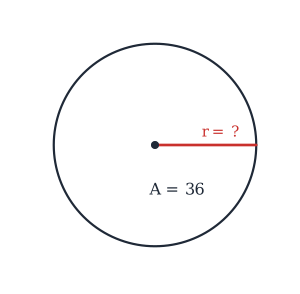
We do that by putting 36 in 's place in the formula for the area:
Now we can see that we have an equation where we have to find , the radius. Remember that is just a number. We get the radius on its own. First we divide by on both sides, so that the radius can stand alone:
Now we can take the square root on both sides, to get completely on its own. We can do that because we have squared, and we can remove the square by taking the square root:
Now we just type this into the calculator and get
It may seem a little complicated, but some questions say that you can use , and then it gets a good deal easier. Then you just calculate with equal to 3 instead.
So we can simply move the formula for the area around, so that it becomes a formula for the radius instead:
That is the same move as rearranging any formula: do the opposite of each thing that's been done to , in reverse order.
Worked examples
Example 1: the area is 36
This is the one above. Divide by , take the square root:
Example 2: the area is 50
Same two steps with 50 in 's place:
So the radius is about 3.99, just under 4.
Example 3: checking against a circle we know
In the area guide we found that a circle with a radius of 3 has an area of about 28.27. Let's run that backwards:
We can check this is right, because we know we started from a radius of 3. The formula lands back where it should, which is a good sign that the two steps are the right ones.
Common mistakes
- "π is another unknown, so I can't solve it." is just a number, about 3.14. There are only two unknowns in the formula, the area and the radius, and once you know one of them you can find the other.
- "There's a fraction with π in it, so it can't be worked out." It's one line on the calculator: . And some questions let you use , which makes it easier still.
Related
What the radius, the diameter and the area of a circle are is in circles. The formula going forwards is in how to find the area of a circle, and the other measurement of the same circle is in how to find the circumference of a circle.
Frequently asked questions
Read next
Want to get good at maths?
Mathara explains every topic step by step with videos, exercises and personal feedback.
👉 Get started for free