Guide
Square roots and cube roots
The square root of a number is the number you multiply by itself to get it, and the cube root is the same idea three times over. Roots are the opposite of powers, which is exactly why they're so useful in equations.
When we talk about roots, the square root is probably the one you think of first. The square root of a number is the number you have to multiply together 2 times to get . A cube root is the same idea with three copies. This guide shows how to find them, the rules they follow, and the one thing about square roots that catches almost everyone out.
When do I use this?
Roots turn up whenever you need to undo a power. Squares and cubes appear in areas, volumes, Pythagoras, and any equation with an or in it. Roots are the opposite of powers, which is the whole reason they matter. If you want the bigger picture first, it's in what indices and roots are.
Finding a square root
It can seem a bit confusing, but if for example we want to find the square root of 4, we have to find the number that gives 4 when multiplied together 2 times. There's no method for finding this number, so it's really just guesswork. But we do know that , so the square root of 4 is 2:
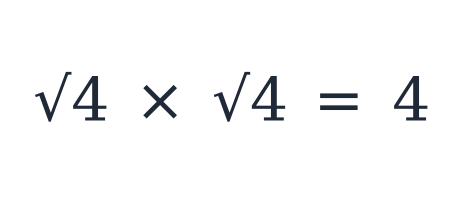
Let's look at one more example:
Here we need the number that gives 9 when multiplied by itself. Let's call that number :
If we try putting 3 in, we get . That's right, so the square root of 9 is 3:
Guesswork is fine here, because 4 and 9 are square numbers. For a number like 7, there's no whole number that works, and that's what the root button on the calculator is for.
Cube roots and higher roots
The same concept applies to all the other roots. The 3rd root, the cube root, is the number that has to be multiplied together 3 times. The 4th root is the number that has to be multiplied together 4 times, and so on. We show which root it is with a small raised number in front of the root sign:
An example of a cube root could be . We need a number that gives 27 when multiplied together 3 times. We can see that if we multiply 3 together 3 times, we get 27:
So the cube root of 27 is 3:
The rules for roots
Just like powers, roots come with a short list of rules:
The first two are what you use to simplify surds. The last three say that a root is really a power with a fraction as the index, which is unpacked in zero, negative and fractional indices.
Roots are the opposite of powers
We saw with roots that we find the number that gives some result when multiplied by itself a certain number of times. For example the square root of 4 is 2, because . That is precisely the same as writing
So there's a connection between powers and roots. When we find a cube root, we're finding a number that, multiplied together 3 times, gives the number we started with:
Powers and roots are actually each other's opposites, just like multiplying and dividing are each other's opposites. This gets used a lot when solving equations, because they cancel each other out. If we have squared, we can take the square root to remove the power:
What we did was remove the power by taking the matching root. If we have we use the square root. If we have we use the cube root, and so on. So if , we take the cube root of both sides and get , because .
Square roots and more than one answer
When we looked at the equation , we found that the answer was 5. That means that when we put 5 in 's place, we get 25. But there's actually one more number that does that, namely . If we put in 's place:
That works too. Negative times negative gives positive, so times gives 25. So this equation actually has two solutions. Both 5 and are solutions.
So you might be thinking: "aren't there two answers to the square root of 25 as well?" Both 5 and multiplied by themselves give 25, after all. But no. When we take square roots, only the positive answer counts. So is not an answer to the square root of 25:
But when we solve equations that involve square roots, we get two solutions. Keep the two situations apart: the root itself is one number, the equation can have two.
Common mistakes
- "." The square root of 25 is 5. The belongs to the equation , which has the two solutions 5 and .
- "There must be a method for working out square roots by hand." There isn't one you're expected to know. For square numbers it's a quick guess, for everything else it's the calculator.
- "Roots and powers are different topics." They're opposites of each other, like multiplying and dividing, and a root is even a power in disguise: .
Related
The two rules for roots of a product and a fraction are what make simplifying surds work. The idea that a root is a power with a fraction as its index is in zero, negative and fractional indices, and the foundation for all of it is what indices and roots are.
Frequently asked questions
Read next
Want to get good at maths?
Mathara explains every topic step by step with videos, exercises and personal feedback.
👉 Get started for free