Guide
Simplifying surds
A surd is a root that doesn't come out as a whole number. We can't write it as a neat number, but we can often write it more neatly, using one rule for roots and a square number that divides in.
A surd is a root that doesn't come out as a whole number, like . There's no method for finding that number exactly by hand, it's guesswork or the calculator, so instead we leave the root sign in. But we can often write the surd more neatly, and that's what simplifying a surd means. The whole method is one rule for roots plus a square number that divides in.
When do I use this?
Whenever an exact answer is asked for and the answer contains a root that isn't a whole number. That happens in Pythagoras, in the quadratic formula, and any time a square root of a non-square number turns up. An exact answer means with the root sign kept, not a rounded decimal. If roots themselves feel new, read square roots and cube roots first.
The rule that does the work
Roots follow a short list of rules, and the two we need here are the ones for a product and a fraction:
In words: the root of a product is the product of the roots, and the root of a fraction is the fraction of the roots. For square roots, is 2 and we just leave it out of the notation.
The procedure
Take .
Step 1: find a square number that divides into the number under the root. The square numbers are and 4 divides into 12, because .
Step 2: split the root with the product rule.
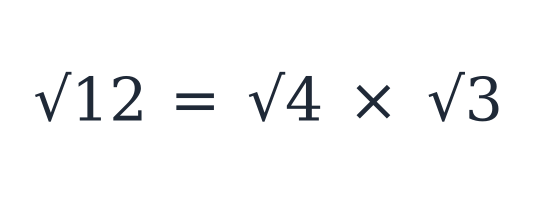
Step 3: take the root you can take. We know that , so :
So . Nothing squared divides into 3, so we can't simplify any further. That's the finished answer.
We can check this is right, because we know the rule runs backwards too: .
If you only spot a smaller square number first, that's fine. You just repeat the step, as the second worked example below shows.
Worked examples
. The square number 25 divides into 50, since :
. Here 36 divides in, since :
If you'd only spotted 4 first, you'd get , and 9 still divides into 18, so one more round gives . Same answer, one step longer.
The rule backwards: . Two roots multiplied together can be joined into one:
A fraction under the root: . The fraction rule splits it into two roots we can take:
Common mistakes
- "There must be a way to work out exactly." There isn't one you're expected to know, and it doesn't come out as a whole number anyway. That's why we leave the root sign in and write .
- "Surds are a separate topic from indices." They're roots, and a root is a power with a fraction as the index. The rule is the same as the law of indices with .
Related
The rules for roots, and why roots are the opposite of powers, are in square roots and cube roots. Their twins for powers are the laws of indices, and the foundation is what indices and roots are.
Frequently asked questions
Read next
Want to get good at maths?
Mathara explains every topic step by step with videos, exercises and personal feedback.
👉 Get started for free