Guide
The laws of indices
There are only a handful of rules for working with powers, and every one of them falls straight out of what a power means. Here is the full list, why each rule works, and worked examples with numbers and letters.
The laws of indices are the short list of rules for working with powers that have the same base. There are only a handful of them, and every single one falls out of the definition of a power: the index tells you how many times the base is multiplied by itself.
If you haven't read what indices and roots are, it's a good idea to read that first, because the rules make far more sense once you read as " multiplied by itself times".
When do I use this?
Whenever two powers of the same base are being multiplied or divided, or a power is being raised to another power. That happens with plain numbers (), and it happens just as often in algebra (). The rules are written with letters, so they cover both. You just put your own number or letter in the base's place.
The rules
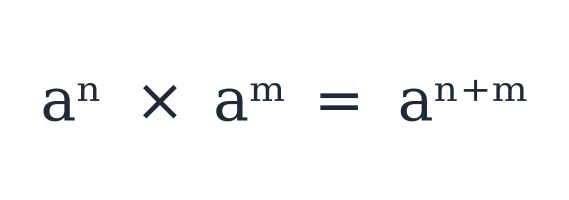
Here is the list, exactly as it's worth memorising:
The small print is there because those rules involve dividing by , and we can't divide by zero.
Why the rules work
We don't have to take the first three on trust. Write the powers out and count.
Multiplying: is two copies of multiplied by three copies of . That's five copies in total:
So the indices add, because the copies add up. That's the first rule.
Dividing: has five copies on top and two underneath. Two of them cancel, and three are left, so . The indices subtract. That's the second rule.
A power of a power: means multiplied by itself 3 times, so , which is six copies of . The indices multiply. That's the third rule.
The last three rules, with the negative index and the zero index, need the idea of a power stretched a little. That gets its own guide on zero, negative and fractional indices.
Worked examples
Multiplying powers. . Same base, so we add the indices:
We can check it is right by writing the powers out: and , and .
Dividing powers. . Same base, so we subtract the indices:
A power of a power. . We multiply the indices:
A product raised to a power. . Each factor gets the power:
which is, after all, the same as .
A fraction raised to a power. . Top and bottom each get the power:
With letters. The rules don't change at all:
If you ever doubt one of these, write the powers out as copies of the letter and count. The rule is just the count done in advance.
Common mistakes
- " means times ." It means multiplied by itself times. So is , not .
- " is 0." It's 1. If you divide by the rule gives , and a number divided by itself is 1.
- "A negative index makes the answer negative." It makes a fraction. , which is positive.
Related
The idea underneath all of this is in what indices and roots are. The rules with a zero, negative or fraction index are unpacked in zero, negative and fractional indices, and since a root is a power with a fraction as the index, the same rules run square roots and cube roots too.
Frequently asked questions
Read next
Want to get good at maths?
Mathara explains every topic step by step with videos, exercises and personal feedback.
👉 Get started for free