Guide
Zero, negative and fractional indices
Multiply a number by itself zero times, or minus two times, or half a time? It sounds odd, but the laws of indices tell us exactly what those powers have to mean. Here is the argument and the worked examples.
A power like or is easy to read: multiply the base by itself that many times. But what if the index were ? Then we'd have to multiply the base together times? Or what if the index were 0? That sounds mysterious with the definition of a power we have right now. So we have to extend our idea of a power a little.
The good news is that we don't get to make anything up. The laws of indices have to keep working, and that decides what these strange powers must mean.
When do I use this?
Whenever a power turns up with 0, a negative number, or a fraction as its index. In GCSE that's things like , , and , and the same three ideas turn up later in every topic that uses indices.
The index is 0
We can start with the strange example where the index is 0:
The rule list says this is 1, but to give a bit of perspective, let's see why. We have a rule that says
That must mean can be rewritten as . We're using 2 as the example here, it could be any other number, as long as the two are the same. Now we can use the rule:
Since we have on both the top and the bottom, the fraction has to be 1. So the rule forces . It isn't a new fact we have to remember on its own. It's the division rule doing what it always does.
The index is negative
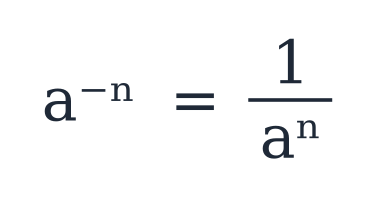
The same trick handles a negative index. From the rule list:
A negative index means one over the power. You can see where it comes from with the division rule again: , and if we write the fraction out, two of the three s underneath cancel with the two on top, leaving . So the "minus" in the index doesn't make the number negative. It moves the power to the bottom of a fraction. That's why can't be 0 here: we'd be dividing by zero.
The index is a fraction
Another example could be an index of . So we'd have to multiply the base together half a time, which sounds strange, but if we grab the rules again it makes more sense. We have a rule that says
If we try multiplying two of these powers together and use the rule, we get
Here multiplied by itself gives . That's a clear link to roots: the square root of is precisely the number that gives when multiplied by itself. So
And this actually holds for all roots:
The rules for roots take it one step further. A fraction like in the index means both a power and a root at once:
The bottom of the fraction says which root, the top says which power. Roots and how they work get their own guide on square roots and cube roots.
Worked examples
Zero index. . Any base except 0 gives 1.
Negative index. . One over the power:
Half as the index. . That's the square root:
We can check this is right, because we know that .
A third as the index. . That's the cube root:
because .
A fraction with a top and a bottom. . The 3 is the root and the 2 is the power:
since .
Negative and a fraction. . The minus moves it under a 1, the half makes it a square root:
Notice that every single one of these was decided by a rule we already had. Nothing new was invented, we just insisted that the rules keep working.
Common mistakes
- " is 0." It's 1. Divide by : the rule gives , and a number divided by itself is 1.
- "A negative index gives a negative number." It gives a fraction. is , a positive number.
- "Roots and indices are different things." A root is a power with a fraction as the index. , so the same rules run both.
Related
The rules themselves are listed in the laws of indices, roots get their full treatment in square roots and cube roots, and the foundation is what indices and roots are. If fractions in the index feel shaky, the fraction rules themselves are in what is a fraction?.
Frequently asked questions
Read next
Want to get good at maths?
Mathara explains every topic step by step with videos, exercises and personal feedback.
👉 Get started for free