Maths dictionary
What is a fraction?
A fraction is made of three parts, a numerator, a fraction bar and a denominator, and the fraction bar is just a division sign. Here is the short explanation with examples and pizza.
Fractions can describe numbers like halves and quarters. A fraction is made of 3 things. A numerator, the top number, a fraction bar, which is the same as dividing, and a denominator, the bottom number.
That is the most important sentence to carry with you: a fraction bar and a division sign actually mean exactly the same thing. Once you understand that, the rest of fraction arithmetic is just different ways of dressing up the same number.
The fraction as a pizza
If we look at a fraction as a way of splitting up a pizza, the denominator tells us how many slices the pizza is split into, and the numerator tells us how many of those slices are ours.
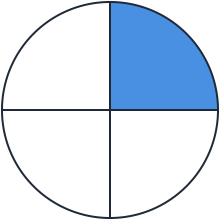
In other words: the pizza is split into 4 slices, and we have 1 of them. That is one quarter.
The three parts of a fraction
A fraction always has the same three parts. We write and on top of each other with a bar between them:
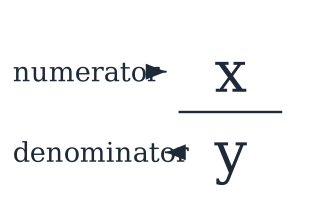
Here is the numerator, and is the denominator. The fraction bar always sits in the middle and tells us that the top is divided by the bottom. That is why
This connection is the one we come back to every single time we do arithmetic with fractions.
When the numerator and denominator are the same
What happens if we take a pizza, split it into 8 slices, and then take all 8 slices?
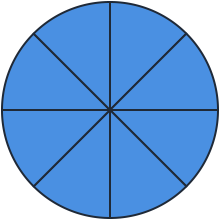
We have all the split-up slices of the pizza, and that is one whole pizza. So when the numerator and denominator are the same number, the fraction equals 1. That is the same as saying that if we divide a number by itself, we get 1.
It is a small rule, but we will need it again and again later, so it is worth taking with us.
The same fraction can look different: equivalent fractions
Here is the slightly surprising part of fractions: the same value can be written in many ways.
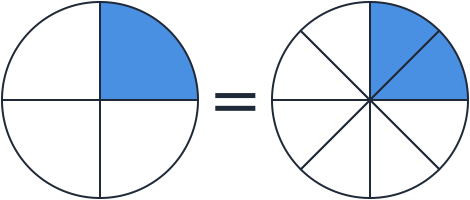
If we look at the pizzas, the two fractions are identical. We have just split the pizza into more slices and made more of the slices ours. The pizza is the same, and the blue part is the same. We have only changed how we count it.
What we did was multiply both the numerator and the denominator by 2:
We call this scaling up the fraction. We make the numerator and denominator bigger, but the meaning of the fraction stays the same. The two ways of writing it are called equivalent fractions. And because scaling up is a multiplication, we can also go the other way and simplify, by dividing both the numerator and the denominator by the same number.
The mysterious fraction. This trick is stronger than it looks. Take, for example,
It looks unmanageable, but it is the same as . The big fraction just shows that the pizza has been split into very many small slices, and that we get very many of the small slices, but it comes to a quarter.
It is always a good idea to simplify fractions as much as possible, so the answer comes out neat. I always try to find a number that divides both the numerator and the denominator, so we can divide by it.
Whole numbers are fractions too
A whole number can be written as the number divided by 1:
So it is not the case that whole numbers are something completely different from fractions. They are just an especially neat kind of fraction, where the denominator is 1. There is more on this in fractions and whole numbers.
What about when the numerator is bigger than the denominator, but it is not a whole number? For example . Then we can write
We can check this is right, because we know that (the numerator and denominator are the same). So: is one whole pizza plus an extra half.
Doing arithmetic with fractions
When we do arithmetic with fractions, there are three situations you will meet again and again: adding, multiplying and dividing.
Adding and subtracting fractions
If the denominators are the same, it is easy. We just add the numerators:
If the denominators are different, we first have to find a common denominator. A smart thing to do is to scale up each fraction by the other one's denominator. That means that to add , we multiply the top and bottom of the first fraction by (which is, after all, the denominator of the other fraction), and the second fraction by . Then they have the same denominator, and then we can add the numerators.
This whole move gets its own guide, how to add fractions, where we go into depth with the common denominator.
Multiplying fractions
To multiply fractions, we multiply numerator by numerator and denominator by denominator:
Notice that we simplify at the end. is correct, but is neater. The full walkthrough is in the guide how to multiply fractions.
Dividing fractions
When we divide by a fraction, we multiply by the flipped fraction instead. It is a short rule, but it gets its own guide, how to divide fractions.
Common misunderstandings
Fractions catch a lot of people out, almost always in the same ways. Here are the ones that most often trip people up:
- "A fraction is two numbers stacked on top of each other." No. The fraction bar is a division sign. A fraction is one thing, not two.
- "Whole numbers are not fractions." They are. Every whole number can be written as .
- " is strange, because there is nothing left over." That is exactly the point. When you have all the slices, you have a whole, and a whole is 1.
- "When I scale up a fraction, the numbers get bigger, so the fraction must get bigger." No. Scaling up only changes how the fraction is written. The value is exactly the same.
- "To add , I multiply numerator by numerator and denominator by denominator." That is the classic mistake. Finding a common denominator is a completely separate step that happens first, and then we only add the numerators.
- "Simplifying is optional." Not really. It is always a good idea to simplify as much as possible, so the answer is neat and easy to compare with everyone else's.
Fractions, percentages and decimals
A fraction is the first place where the same number can be written in several ways, and the two topics that follow fractions are really two more ways of writing the same numbers:
- A percentage is a fraction with 100 as the denominator. Per cent means hundredths, so .
- A decimal is the same value written with a decimal point instead of a fraction bar. is a whole and a half, so .
How the three forms fit together is in the guide fractions, decimals and percentages.
Guides on fractions
Guides on this topic
Equivalent fractions: scaling up and simplifying
Two fractions can look different and still be the same number. We get from one to the other by multiplying or dividing both the numerator and the denominator by the same number. Here is how, and why it works.
Fractions and whole numbers
Whole numbers and fractions are not two different kinds of number. A whole number can always be written as a fraction with 1 as the denominator, and a fraction like 3/2 can be split into 1 + 1/2.
Fractions, decimals and percentages: the same number in three forms
A half can be written as 1/2, as 0.5 or as 50%. They look different, but they're the same number. This guide shows how the three forms connect and gives the conversions worth knowing by heart.
How to add fractions
Adding fractions is easy when the denominators are the same. When they're different, we first scale the fractions up to a common denominator, and then we add the numerators. Here is the whole move with examples.
How to divide fractions
When we divide by a fraction, there's a little trick: we turn the last fraction upside down and multiply instead. It sounds strange, but it turns division into multiplication, which we already know how to do.
How to multiply fractions
Multiplying two fractions is the simplest operation there is for fractions, simpler than adding. We multiply numerator by numerator and denominator by denominator, and simplify at the end.
Frequently asked questions
Read next
Want to get good at maths?
Mathara explains every topic step by step with videos, exercises and personal feedback.
👉 Get started for free