Maths dictionary
What is a percentage?
Per cent means hundredths, so every percentage is a fraction with 100 on the bottom. Here is what that means, and the four kinds of percentage question you will meet in GCSE maths.
Per cent means hundredths, that is , and it has the sign %. Percentages are an easy way to find how much one number is of another. We can also rewrite percentages as fractions and decimals, and the other way round.
That last sentence is the whole secret. Since per cent means hundredths, we can, for example, write 10% as , or as the decimal 0.1.
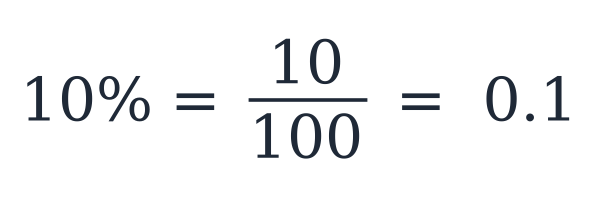
Three ways of writing it, one number. Once you see that, a percentage stops being a new kind of number with its own rules. It is a fraction that always has 100 as its denominator, and it can be written as a decimal whenever that is handier.
A percentage is a fraction with 100 on the bottom
The % sign is really a short way of writing "divided by 100". So 25% is , 50% is , and 100% is , which is one whole. Nothing new has to be learned to work with percentages. Everything we can do with fractions, we can do with percentages, because they are fractions.
That is also why the word "whole" matters so much in percentage questions. Whatever we are taking a percentage of is the whole, and the whole is 100%. Once we have decided what the whole is, the rest is fraction arithmetic.
Finding a percentage of a number
Let's say we had to find 15% of 60. Here 60 is the whole, that is 100%, so we have to find of it. An easy way to do this is to find 1% of 60, and then find 15% by multiplying by 15. We know that 1% is , so we can find 1% by dividing by 100:
So we find how much 1% of 60 is, and then we multiply by 15 to find 15% of 60, which is 9. That move, find 1% and then multiply, is the one to carry with you. It gets its own guide about finding a percentage of an amount.
The four types of percentage problem
In percentage calculations there are several ways we can work with percentages. It helps to know which type of question you are looking at, because each type has its own short rule.
Find a percentage of a number. Find the number that corresponds to a percentage of another number. For example, 20% of 60. We find 1%, which is , and then multiply by the number of per cent we want. More generally, of is
This is the guide how to find a percentage of an amount.
Find what percentage one number is of another. For example, how many per cent is 20 of 60? We set up the fraction , because it tells us how much 20 is of 60, and then we multiply by 100 to get it in per cent. More generally, as a percentage of is
This is the guide how to write one number as a percentage of another.
Find the whole from a percentage. Find 100% when you know what a certain percentage is. For example, find the whole when we know that 20% is 35. We find 1% by dividing by 20, and then multiply by 100. More generally, if corresponds to , the whole is
This is the guide about reverse percentages.
Find a percentage increase or decrease. Find how much a number has gone up or down, in per cent. We first find the change, and then look at how big the change is compared with the starting value. More generally, a percentage change from to is
This, together with adding or taking off a percentage using a multiplier, is the guide about percentage increase and decrease.
Percentages in everyday life: VAT and interest
Two places where you meet percentages every week are prices and bank accounts.
When we buy something, there is a tax on it that we call VAT. In the UK, VAT is 20%, so a price with VAT is the price without VAT plus 20% of it. Going from the price without VAT to the price with VAT is a percentage increase. Going back the other way, from a price with VAT to the price without, is the classic reverse percentage question, and it is not as simple as taking 20% off again. Both directions are in the guides linked above.
When we talk about interest, we are actually talking about a type of function called an exponential function. If you have some money in a bank account and get a certain rate of interest per year, the interest formula tells you how much you have after a number of years. That is the guide about compound interest.
Common misunderstandings
- "A percentage is a special kind of number with its own rules." It is not. Per cent means hundredths, so a percentage is a fraction with 100 as its denominator, and the fraction rules are all you need.
- "You have to memorise a pile of percentage formulas." You have to remember one thing: . If you can work with fractions or with decimals, you can work with percentages.
- "15% of 60 needs its own special method." Call 60 the whole, that is 100%, and the question turns into finding of 60. Find 1%, then multiply by 15.
- "If I add 20% and then take 20% off, I am back where I started." No. The 20% you take off is 20% of a bigger number than the 20% you added. This is exactly what makes reverse percentages worth their own guide.
Related guides
Guides on this topic
Compound interest: the interest formula
The interest formula tells you how much money you have after a number of years at a given rate of interest. Here is what each letter means, why we multiply by 1.02 and not 0.02, and two worked examples.
How to find a percentage of an amount
To find a percentage of an amount, find 1% of it by dividing by 100 and then multiply by the number of per cent you want. Here is the method with worked examples.
How to write one number as a percentage of another
To find what percentage one number is of another, write the first number over the second as a fraction and multiply by 100. Here is the method with worked examples.
Percentage increase and decrease with a multiplier
Adding a percentage is a multiplication by a number a bit bigger than 1, and taking a percentage off is a multiplication by a number a bit smaller than 1. Here is how, with VAT and price examples.
Reverse percentages: finding the original value
A reverse percentage runs the usual question backwards: you know the result and have to find what you started with. Here are the two situations you will meet, with worked examples.
Frequently asked questions
Read next
What is a fraction?
DictionaryWhat are decimals?
GuideHow to find a percentage of an amount
GuideHow to write one number as a percentage of another
GuidePercentage increase and decrease with a multiplier
GuideReverse percentages: finding the original value
GuideCompound interest: the interest formula
Want to get good at maths?
Mathara explains every topic step by step with videos, exercises and personal feedback.
👉 Get started for free