Guide
How to divide fractions
When we divide by a fraction, there's a little trick: we turn the last fraction upside down and multiply instead. It sounds strange, but it turns division into multiplication, which we already know how to do.
When we divide fractions by each other, there's a little trick we do. We take the fraction we're dividing by, turn it upside down, and then multiply instead. It sounds a bit strange, but it works every time, and it means that division turns into something we already know how to do.
The trick
An example could be
The trick is that we take the last fraction and turn it upside down. That is, we swap the numerator and the denominator, so becomes . Then we multiply the new, flipped fraction by the first fraction. It sounds a bit strange, but it looks like this:
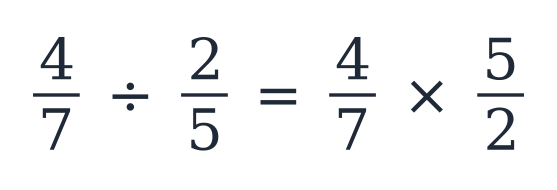
So when we divide two fractions, we start by taking the last fraction and swapping its numerator and denominator. Afterwards we multiply the new, flipped fraction by the first one. Multiplying is the easy part, numerator by numerator and denominator by denominator, exactly as in how to multiply fractions:
That is the right answer. It's always a good idea, when we calculate with fractions, to simplify the answer as much as possible. goes into both and , so
So: , which is a bit more than one whole.
The rule in general
Written with letters, the trick looks like this:
When we divide fractions by each other, we take the fraction we divide by and turn it upside down, so the numerator becomes the denominator and the other way round. Then we multiply the fractions together. Here , , and are numbers we choose ourselves.
One more example
Let's take . We turn the last fraction upside down, so becomes , and multiply:
Notice that is just the whole number written as a fraction, so dividing by a half is the same as multiplying by . You can read more about that in fractions and whole numbers. And can't be simplified, because no number goes into both and .
Things to watch out for
- It's the last fraction that gets flipped. The fraction we divide by is the one we turn upside down. The first fraction stays exactly as it is. If you flip the first one instead, you're working out a completely different sum.
- Don't forget to simplify at the end. An answer like is correct, but is neater. I always try to find a number that goes into both the numerator and the denominator, which we can divide by.
Related
Dividing fractions builds directly on multiplying them, so if that step feels shaky, how to multiply fractions is the place to go. Adding works differently and needs a common denominator, which you can see in how to add fractions. The foundation under it all is in What is a fraction?.
Frequently asked questions
Read next
Want to get good at maths?
Mathara explains every topic step by step with videos, exercises and personal feedback.
👉 Get started for free