Guide
Equivalent fractions: scaling up and simplifying
Two fractions can look different and still be the same number. We get from one to the other by multiplying or dividing both the numerator and the denominator by the same number. Here is how, and why it works.
Fractions can be scaled up, which means that we can make the numerator and the denominator bigger or smaller without changing what the fraction means. That is, without changing how much of the pizza is ours. Two fractions that look different but mean the same are called equivalent fractions, and moving between them is the move that makes the rest of fraction arithmetic work.
Scaling up: same pizza, more slices
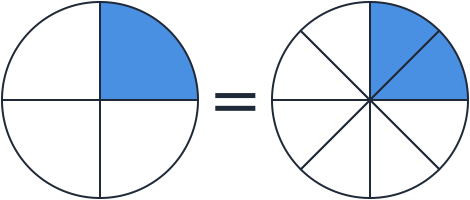
If we, for example, scale up the fraction by 2, meaning we multiply both the numerator and the denominator by 2, we get the fraction
If we look at the pizzas, the two fractions are identical. We have just split the pizza into more slices and made more of the slices ours, but we can see that we get the same amount of pizza.
Written with letters, the rule is
We can scale up fractions by multiplying by the same number in both the numerator and the denominator. Here is the number we choose to scale up by. It can be anything, as long as it's the same number on top and underneath.
Scaling up to a denominator we want
Most of the time we scale up because we need a particular denominator, for example when we add fractions with different denominators. Say we want to write with 10 underneath. To turn the 5 into 10 we multiply by 2, and then the numerator has to be multiplied by 2 as well:
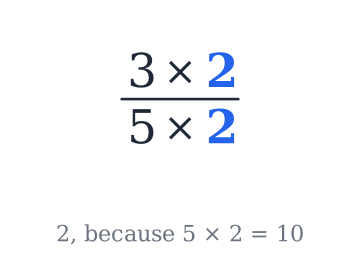
So and are the same fraction, and the second one is ready to be added to anything else with 10 underneath.
Scaling down: simplifying
We can scale fractions both up and down. That has its advantages when we work with numbers we can't quite relate to. Then we can use scaling to get an overview of what a fraction is actually telling us. Take, for example,
The mysterious fraction, we could call it. It looks unmanageable, but if we divide both the numerator and the denominator by , and then by , we end up here:
So the mysterious fraction is the same as a quarter. This big fraction just shows that the pizza is split into very many small slices, and that we get very many of the small slices, but it comes to a quarter.
Scaling down is called simplifying, and the rule is the same move run backwards:
We can simplify fractions by dividing by the same number in both the numerator and the denominator.
How to find the number to divide by
It's always a good idea, when we calculate with fractions, to simplify them as much as possible. That means we make them as small as we possibly can. Take , the kind of fraction that comes out of a multiplication. If we divide both the numerator and the denominator by , we get
and this fraction can't be simplified any further.
It can be a bit hard to see how to simplify a fraction. I always try to find a number that goes into both the numerator and the denominator, which we can divide by. If you don't see one straight away, you can simplify in several steps, as we did with the mysterious fraction: first by , then by .
Common mistakes
- "When I scale up a fraction, the numbers get bigger, so the fraction must get bigger." No. Scaling up only changes how the fraction is written. The pizza is the same, we have just split it into more slices and made more of them ours.
- "Simplifying is optional." Not really. It's always a good idea to simplify as much as possible, so the answer comes out neat and is easy to compare with everyone else's.
- "I can't find a number that divides both." Try to find a number that goes into both the numerator and the denominator. If you can't find one that does the whole job at once, simplify in steps: divide by one number you can see, and look again.
Related
Scaling up is the first step every time you add fractions with different denominators, and simplifying is the last step every time you multiply fractions. The special cases where the numerator and denominator are equal, or the denominator is 1, are in fractions and whole numbers. The foundation under it all is in What is a fraction?.
Frequently asked questions
Read next
Want to get good at maths?
Mathara explains every topic step by step with videos, exercises and personal feedback.
👉 Get started for free