Guide
Fractions, decimals and percentages: the same number in three forms
A half can be written as 1/2, as 0.5 or as 50%. They look different, but they're the same number. This guide shows how the three forms connect and gives the conversions worth knowing by heart.
A half can be written as , as or as . They look different, but they're the same number written in three different ways, and the point of this guide is to make switching between them automatic.
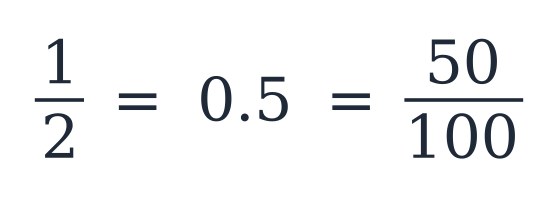
Per cent means hundredths
Per cent means hundredths, that is , and it has the sign . Percentages are an easy way to find how much one number makes up of another. We can also rewrite percentages as fractions and decimals, and the other way round. Since per cent means hundredths, we can describe as , or as the decimal :
That one line is the whole connection between percentages and the other two forms. A percentage is a fraction with 100 as the denominator, and if you can write a number as hundredths, you can write it as a percentage. You can read more in What is a percentage?.
Decimals and fractions
Decimals are a way of writing numbers that aren't whole. That could be, for example, . Here we see , which is a whole, and , which is half of , so a half. We can also write this decimal as a fraction. We know from What is a fraction? that a fraction with the same numerator and denominator is a whole. The number consists, as we said, of a whole and a half, so we can write it as
Or, if we only want one fraction,
Why ? Because is, after all, a whole, and from there we have left. So one and a half. That move is explained in fractions and whole numbers.
Going the other way, remember that the fraction bar is a division sign. So is , and on a calculator that gives .
The list worth knowing by heart
Some connections we just need to have at our fingertips, so learning this list by heart will help. The little line over a digit means that the decimals continue forever.
| Decimal | Fraction |
|---|---|
| approximately | |
Notice that is the only one written as "approximately". Its decimals carry on without a neat repeating pattern, so is a rounded value, while every other line is exact.
From the list to percentages
Because per cent just means hundredths, moving from the list to percentages is one more step: write the decimal as hundredths, and the number of hundredths is the percentage.
So a quarter of something is of it, a fifth is , and the whole thing is . The same number, three forms, and you pick whichever one makes the calculation easiest.
Common misunderstandings
- " and are different numbers, because they look different." They are the same number. is half of , and half of is .
- " is exactly ." No. The dot over the digit means the decimals continue forever. is a rounded value, is the exact one.
- "Percentages are a separate kind of number with their own rules." A percentage is just a fraction with 100 as the denominator. If you can calculate with fractions or decimals, you can calculate with percentages.
Related
The building blocks are in What is a fraction?, What are decimals? and What is a percentage?. Rewriting a fraction with 100 underneath is scaling up, which is covered in equivalent fractions.
Frequently asked questions
Read next
Want to get good at maths?
Mathara explains every topic step by step with videos, exercises and personal feedback.
👉 Get started for free