Guide
Fractions and whole numbers
Whole numbers and fractions are not two different kinds of number. A whole number can always be written as a fraction with 1 as the denominator, and a fraction like 3/2 can be split into 1 + 1/2.
We can easily write whole numbers, like 2, as a fraction. That means whole numbers and fractions aren't two different kinds of number, just two ways of writing the same thing, and being able to switch between them is something we need all the time.
A whole number as a fraction
If we pretend the pizza is split into 1 slice and we have 2 slices, then we have 2. This happens when the numerator is bigger than the denominator:
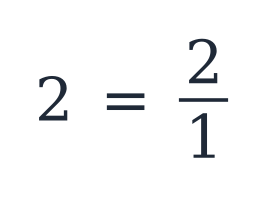
If we looked at it as a division, we would say "how many times does 1 go into 2?", which it does 2 times. The fraction bar is a division sign, after all, and dividing by 1 gives the number straight back. Written with a letter, the rule is
A whole number can be written as the number divided by 1. That goes for any number: and .
When the numerator and denominator are the same
The other special case is when the numerator and the denominator are the same number. Let's look at a pizza split into 8 slices, where we have 8 of them, so all of them:

We can see on the figure that we have the whole pizza. So we can say that we have 1 whole pizza. When we have all the split-up slices of the pizza, we have a whole. So when the numerator and the denominator are the same number, the fraction is 1.
When it doesn't go up exactly
Sometimes the division doesn't go up, so we end up with both a whole number and a fraction. Take
In this fraction we can see that 2 goes into 3 once, but then we have left. So:
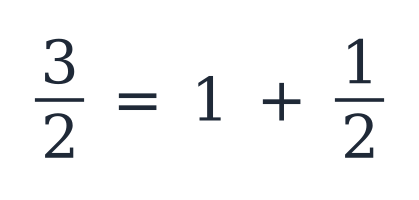
So the fraction three halves is the same as one and a half. We can check this is right, because we know that we can write a whole, 1, as a fraction where the numerator and denominator are the same number:
That way we can write whole numbers as fractions, and fractions as a whole number plus a bit.
The same move works for any fraction where the numerator is bigger than the denominator. Take . Here 3 goes into 7 twice, that's , and then there's left:
Multiplying a fraction by a whole number
Because a whole number is just a fraction with 1 underneath, multiplying a fraction by a whole number is simple. The rule is
When we multiply a fraction by a whole number, we multiply the whole number into the numerator. For example
which is . This fits with the rule for multiplying fractions: if we write as , then numerator by numerator gives , and denominator by denominator gives .
Common misunderstandings
- "Whole numbers are not fractions." They are. Every whole number can be written as , because dividing by 1 gives the number back.
- " is strange, because there is nothing left over." That is exactly the point. When you have all the slices, you have a whole, and a whole is 1.
Related
Splitting into uses the fact that , the same fact that makes equivalent fractions work. Whole numbers written as fractions also turn up when you add fractions and when you switch between fractions, decimals and percentages. The foundation under it all is in What is a fraction?.
Frequently asked questions
Read next
Want to get good at maths?
Mathara explains every topic step by step with videos, exercises and personal feedback.
👉 Get started for free