Guide
How to add fractions
Adding fractions is easy when the denominators are the same. When they're different, we first scale the fractions up to a common denominator, and then we add the numerators. Here is the whole move with examples.
Adding fractions is easy when the two fractions have the same denominator. When they don't, we first have to give them one, and that is the step that catches most people out. Here is the whole move, in the order we actually do it.
When the denominators are the same
Let's take an example where we add two fractions:
When we have two fractions with the same denominator, here 7, we add the numerators. So . That gives
The denominator stays as it is. All the slices are still sevenths of the pizza, we just have more of them now.
When the denominators are different
Often the fractions we have to add don't have a common denominator. That could be in this example:
When we don't have a common denominator, we first have to find one. We do that by scaling the fractions up or down until they have a common denominator. If you haven't read the guide on equivalent fractions, it's a good idea to read that first.
A smart thing to do is to scale up the fractions by each other's denominators. It sounds a bit strange, but it means that when we scale up the first fraction, , we multiply both the numerator and the denominator by , which is, after all, the denominator of the other fraction:
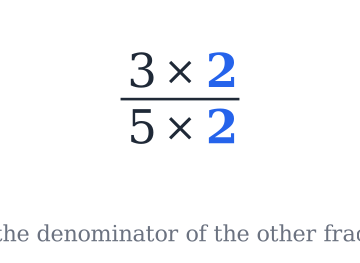
So the first fraction becomes
Now we do the same with the other fraction. This time we multiply by , because that is the denominator of the first fraction:
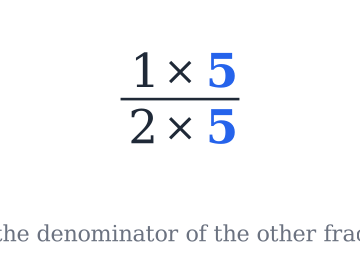
So the second fraction becomes
Now we have two new scaled-up fractions that have the same denominator!
And now we can simply add the numerators:
That is the answer. It's always a good idea, when we calculate with fractions, to simplify the answer as much as possible, but can't be simplified, because no number goes into both 11 and 10. It is a bit more than one whole pizza: 10 tenths make a whole, and then there's one tenth left, so . You can read more about that in fractions and whole numbers.
The rule in general
If we write the same move with letters, it looks like this:
If we have to add fractions, we first find a common denominator. We do that by scaling up one fraction by the other fraction's denominator, and the other way round. Then we add the numerators. Here , , and are numbers we choose ourselves, so if you use the rule, you just put your own numbers in the letters' places. With , , and it gives exactly what we got above:
Subtracting fractions
When we subtract fractions, exactly the same principle applies, actually. If we already have a common denominator, we can just subtract the numerators. If we don't, we first have to find a common denominator, and then we subtract the numerators:
Common mistakes
- "To add , I multiply numerator by numerator and denominator by denominator." That is the classic mistake. That is the rule for multiplying fractions, not for adding. Finding a common denominator is a separate step that happens first, and then we only add the numerators.
- "I don't know which number to scale up by." The simplest choice is the other fraction's denominator. Scale up each fraction by the other one's denominator, and you always end up with a common denominator.
- "I only multiply the numerator when I scale up." When we scale up a fraction, the same number multiplies both the numerator and the denominator. Otherwise the fraction changes its value, and then it's no longer the same fraction.
- "Simplifying at the end is optional." It's always a good idea to simplify the answer as much as possible, so it comes out neat and easy to compare with everyone else's.
Related
Scaling up is the hard step in the whole move, and it has its own guide: equivalent fractions. Multiplying follows a different, simpler rule, which you can see in how to multiply fractions, and dividing builds on that in how to divide fractions. The foundation under it all is in What is a fraction?.
Frequently asked questions
Read next
Want to get good at maths?
Mathara explains every topic step by step with videos, exercises and personal feedback.
👉 Get started for free