Guide
Simultaneous equations: the substitution method
Two equations with two unknowns can be solved by substitution: get one unknown on its own in one equation, put that expression into the other equation, and you are left with one ordinary equation to solve.
Sometimes we have to find two unknowns at once, so both an and a . One equation with two unknowns can't be solved on its own, but with two equations we can pin both values down. There are several methods, and the one I like best is the substitution method. The usual hurdle is stopping halfway, with an expression for instead of a value.
When do I use this?
Sometimes we come across equations with several unknowns, where we have to find a value for both and . To solve them, we need just as many equations as we have unknowns. One equation with several unknowns can't be solved; we can only guess at what the different values might be. Let's take an example with two equations, where we have to find two unknown values:
Here we have to find out what both and are. So there are two different values we have to find. When we have several equations that have to be solved together like this, we call it a system of equations. At GCSE they're called simultaneous equations.
The procedure
The substitution method is about making an expression for one of the variables, which we can then put in the variable's place in the other equation.
- Pick one equation and one variable, and get that variable on its own. That gives an expression for it. It doesn't matter which variable and which equation you go for, but some variables are easier to make an expression for than others.
- Put that expression in the variable's place in the other equation. Now the other equation has only one unknown in it, so we can solve it like any equation.
- Put the value you found back into one of the equations to find the other variable.
Worked example
In this system we could make an expression for from the first equation, because stands almost alone there already. When we make an expression for a variable, we actually just get it on its own:
In this equation we can get on its own by taking away on both sides:
This is now what equals. It's not our final solution for , because we don't have an exact value yet. But this so-called expression for we put in 's place in the other equation:
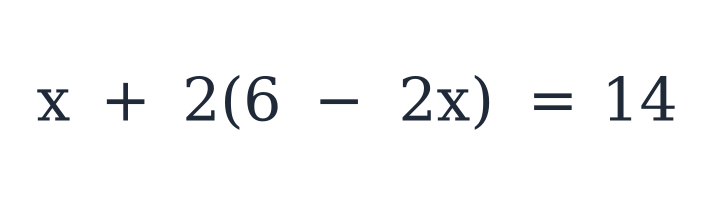
So now we've put the expression for in 's place in the other equation, and what we notice is that we now only have one unknown, . That means we can now solve the equation for . First we multiply the 2 into the bracket (see expanding a single bracket):
Then we do the opposite of on both sides, and afterwards the opposite of "times ":
You'll sometimes see that whole jump written with a double arrow, . The strange arrow just means "is equivalent to".
We now have our solution for , but we still lack the solution for . So we can put our value for in 's place in one of the equations. It doesn't matter which equation we use to find the other variable. Let's use the first:
And after putting the solution for into one of the equations, we can see that we have the solution for both and :
We can check this is right, because we know both values have to fit the other equation too: . That was the so-called substitution method, because we substitute the expression for one variable into the other equation.
Other methods
There are other methods too, like the elimination method, which solves exactly the same system and gives exactly the same answer. For systems with more than two unknowns, a calculator or a CAS tool is perfectly fine to use. But it's always a good idea to practise solving 2 equations with 2 unknowns by hand, because it shows a real understanding of what's going on.
Common mistakes
- ", so that's my answer for ." It isn't. It's an expression for , not a value. It only becomes a value once we know and put it back in.
- "I found , so I'm done." We still lack . Put the value of into one of the equations and find as well. The solution is the pair , .
- "If I'd picked the other equation, I'd get a different answer." No. It doesn't matter which variable and which equation you go for. The answer belongs to the system, not to your choice.
Related
Frequently asked questions
Read next
Want to get good at maths?
Mathara explains every topic step by step with videos, exercises and personal feedback.
👉 Get started for free