Guide
Simultaneous equations: the elimination method
The elimination method makes the coefficients of one unknown equal in both equations, so that unknown goes out with itself and you are left with one ordinary equation to solve.
The elimination method solves two equations with two unknowns by getting equal coefficients for one of the variables in the two equations. Then that variable goes out with itself, and we're left with one ordinary equation. The usual hurdle is multiplying only part of an equation when you make the coefficients equal.
When do I use this?
When we have a system of two equations with two unknowns, like
and we'd rather not get a variable on its own first, as we do in the substitution method. Both methods work on any such system, and they give the same answer.
The procedure
As the name hints, this method is about getting equal coefficients for one of the variables in the two equations. Remember that coefficients are the numbers that are multiplied on our variables.
- Choose a variable, and multiply one of the equations so that the number in front of that variable (the coefficient) becomes the same in both equations. Multiply the whole of both sides, not just the one term.
- Set the equations equal to each other. We can do that in several ways, but what all the ways have in common is that both equations have to equal the same thing.
- The variable with the equal coefficients goes out with itself, so we end up with one equation in one unknown. Solve it as a completely normal equation.
- Put the value back into one of the original equations to find the other variable.
Worked example
Here we'd like the number in front of or (the coefficient) to become equal in both equations. We want that because we later set them equal to each other, where we'll see that the variable with the equal coefficients goes out with itself, so we end up with an equation with one unknown.
If we make the -coefficients equal in the two equations, we have to multiply equation 2 by 2. That is, we multiply by 2 on both sides, so that becomes :
We remember, of course, that we have to multiply the whole of the left-hand side by 2 and not just . Now we have the two equations, where the -coefficients are equal:
We can set these equations equal to each other in several ways, but what the ways have in common is that both have to equal the same thing. So one of the sides in both equations has to give the same. We could move the right-hand side over in both equations, so they both give 0, and then set them equal to each other:
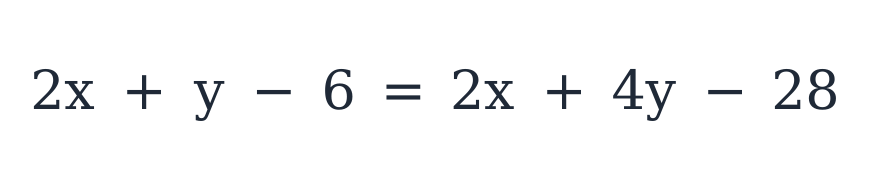
We see that stands on both sides, so they go out with each other:
Now we solve the equation for , as a completely normal equation. We take away on both sides, and then add 28 on both sides:
Now that we have the value for , we can put it into one of the equations to find :
We take away on both sides. To do that, we write 6 as (see equivalent fractions):
So in this method we made the coefficients equal for one of the variables (), after which we set them equal to each other to find the other variable (). The other variable () we then used to find the first (). We set the equations equal to 0, but we could just as well have set them equal to the variable that we made equal coefficients for, which in our example was .
It's the same answer as the substitution method gives, and , which is exactly as it should be. The answer belongs to the system of equations, not to the method.
Common mistakes
- "I multiplied equation 2 by 2 and got ." We have to multiply the whole of both sides by 2, not just the -term. gives .
- "I found , so I'm done." We still lack . Put into one of the original equations and solve for .
- "Elimination gave me a different answer from substitution, so one of them must be wrong." They give the same and for the same system. If they differ, there's a slip somewhere, usually in the multiplying step.
Related
Frequently asked questions
Read next
Want to get good at maths?
Mathara explains every topic step by step with videos, exercises and personal feedback.
👉 Get started for free