Maths dictionary
Trigonometry: sine, cosine and tangent
Sine and cosine are simply the coordinates of a point on the unit circle, and tangent is built from them. Once you see that, the formulas for triangles stop being things to memorise.
You've almost certainly seen , and , which are functions that belong under the topic "trigonometry". With them we can do all sorts of things, such as find lengths, angles and areas of shapes. Trigonometry can seem overwhelming to begin with, because it's a new way of thinking in maths, so we start with the very basics.
The unit circle
Trigonometry starts with a circle that has its centre at the point and a radius of . We know this circle as the unit circle, and it's here we define what sine, cosine and tangent are.
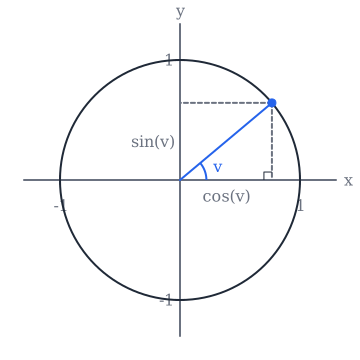
If we make a point () on the circle's circumference and let the radius go out to that point, an angle is formed between the x-axis and the radius. We call that angle .
The x-coordinate of the point is what we call the cosine of the angle , written . The y-coordinate of the point is what we call the sine of the angle , written . Notice how they depend on the angle. When the angle changes, cosine and sine change too.
And that's actually all sine and cosine are. They're the coordinates of a point on the circumference of the unit circle, and that point depends on the angle. If coordinates and the coordinate system feel rusty, that's the one thing worth brushing up before going on.
Sine and cosine are never bigger than 1
When the point sits in different places on the circumference, we of course get different sine and cosine values. But what they all have in common is that they can't get bigger than or smaller than . That's because we're in the unit circle, which has a radius of . No point on it is more than away from the centre in any direction.
The values you can read off
Let's look at some of the simple sine and cosine values, to help the understanding along.
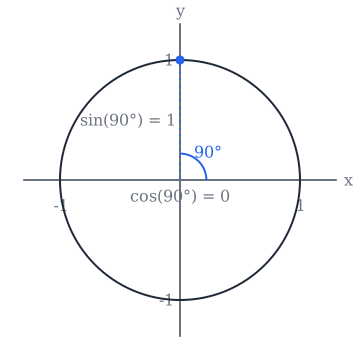
If the point sits at the very top of the circle, so that an angle of degrees is formed, the sine, which is after all the y-coordinate of , can be seen to be at its highest, which is exactly . The cosine is the x-coordinate, and that's , because the point sits on the y-axis. So we can write:
What if the angle was ? Then the point sits down on the x-axis, so the x-coordinate is , and with it the cosine of the angle is . For the same reason the sine of the angle is , because the point's y-coordinate is :
These are some of the sine and cosine values we can actually read off when we look at the unit circle. We can't always. How would you read off ? You can't, so sine and cosine are typically values you look up. Today that means pressing the sin or cos button on a calculator.
It can maybe seem very confusing with all these names, points and x- and y-coordinates, but just remember: cosine is the x-coordinate, sine is the y-coordinate. When you have to find sine and cosine values, you just look at the x- and y-coordinates of the point.
Sine and cosine as lengths
Quite often it's an advantage to see cosine and sine as lengths, and not just as x- and y-coordinates of a point. What do I mean by that? If we isolate the triangle that's formed in the unit circle between the radius, the cosine and the sine, we can see that two of the side lengths actually are sine and cosine:
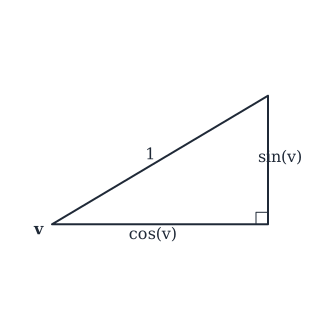
This gives us a huge advantage in understanding when we have to calculate lengths and angles in triangles. That's the whole idea behind the guide on sin, cos and tan in right-angled triangles. But before that, we just need to define what tangent is, because it's a bit more special than sine and cosine.
Tangent
Tangent, , gets its own section because it's a bit different from and in its definition. Tangent is also a trigonometric function, like sine and cosine, but it's defined in a slightly different way.
Tangent is the crossing point between the radius and the tangent line to the circle at the point , that is, the vertical line that just touches the circle there. If we let the radius carry on, it crosses that vertical line. The y-coordinate of the crossing point is what we call , the tangent of the angle.
The length up to the crossing point, which is after all also its y-coordinate, is . The bigger the angle gets, the bigger the tangent gets too. But there comes a point where the angle never crosses this tangent line. That's exactly when the angle is a right angle. Then the radius and the tangent line are parallel. So the tangent of degrees is not defined:
We can actually also define tangent with the help of sine and cosine. The small triangle inside the circle (with sides , and the radius ) and the big triangle out to the tangent line (with sides , and the extended radius) are similar triangles, so the ratio between their sides is the same. Calling the corners , , for the small one and , , for the big one:
Here the line is actually , is , is and is the radius of the unit circle, so :
Which simply reduces to
We can now see why the tangent of the angle is a bit different, because it's defined from the two other trigonometric functions, sine and cosine.
Trigonometry in triangles
What we use trigonometry for most is finding angles and lengths in triangles. In a right-angled triangle, sine, cosine and tangent turn into three short formulas built from the sides. Where they come from, and the names of the sides, is in the guide on sin, cos and tan in right-angled triangles, and using them on a real problem is in finding a side with trigonometry. Note that those formulas can only be used in right-angled triangles.
For any other triangle we use some other formulas: the sine rule and the cosine rule. The best thing about them is that we can use them on every triangle there is. They aren't tied to the right-angled triangle, the way Pythagoras' theorem is.
Common misunderstandings
- "Sine and cosine are just ratios of sides in a right-angled triangle." They're coordinates of a point on the unit circle. The side ratios come out of that, as a consequence, once you take the triangle out of the circle. Starting from the circle is what makes sine and cosine work for any angle.
- "Trigonometry is just formulas to memorise." Every formula here comes from one picture, the unit circle. If you can draw the circle with a point on it, you can rebuild the formulas.
- "You work out sin 65° by hand somehow." You don't. Apart from the simple angles like and , sine and cosine are values you look up on a calculator.
- "The circle definition and the triangle definition are two different things." They're the same thing. The triangle inside the unit circle has and as two of its sides. Scale it up, and you have any right-angled triangle.
- "tan 90° is some big number." It isn't a number at all. At the radius runs parallel to the tangent line and never crosses it, so is not defined.
- "The formulas with opp, adj and hyp work in any triangle." They only work in right-angled triangles. For other triangles you need the sine rule or the cosine rule.
Related guides
Guides on this topic
Finding a side with trigonometry
When you know an angle and one side of a right-angled triangle, one of the three trigonometry formulas gives you another side. Here is the worked example from the book, step by step.
Sin, cos and tan in right-angled triangles
The three trigonometry formulas for right-angled triangles are not three things to memorise. They are the unit circle, scaled up by the hypotenuse. Here is how the sides are named and where the formulas come from.
The cosine rule
The cosine rule lets you find a side from two sides and the angle between them, or an angle from three sides, in any triangle. Here are the three versions and both worked examples from the book.
The sine rule
The sine rule links each side of a triangle to the angle opposite it, and it works on every triangle there is. Here is what it says, what you need to know to use it, and a worked example.
Frequently asked questions
Read next
Want to get good at maths?
Mathara explains every topic step by step with videos, exercises and personal feedback.
👉 Get started for free