Guide
The sine rule
The sine rule links each side of a triangle to the angle opposite it, and it works on every triangle there is. Here is what it says, what you need to know to use it, and a worked example.
The sine rule is an important tool we use when we calculate on triangles. It says something about the relationship between an angle and the side that belongs to it, and how this relationship fits together with the other angles and side lengths in the triangle. The thing to get right is which side belongs to which angle. After that, using it is one line of rearranging.
When do I use this?
You use the sine rule in a triangle that is not necessarily right-angled, when you know an angle and the side opposite it, plus one more quantity, and want another side or angle. If the triangle has a right angle, the three formulas with opp, adj and hyp from sin, cos and tan in right-angled triangles do the job. If you know three sides, or two sides and the angle between them, it's the cosine rule you want instead.
What the sine rule says
Here we can see how the ratio between the side length and the sine of the angle is exactly as big as the ratio between the other angles and their side lengths. The naming is the usual one for triangles: capital letters for the corners (the angles), and the small letter for the side opposite each corner:
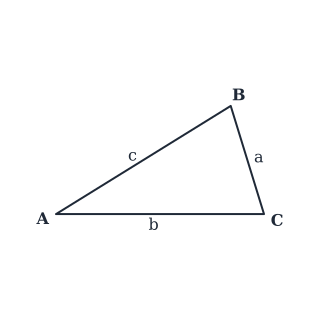
So if we have an angle and its side, plus one other quantity, we can find all the angles and side lengths in the triangle. But it does require that we know a pair, an angle and a side length that belong together, and then any other quantity. An example could be that , and are known:
With that information we can find side .
Worked example
Let's take an example. We've been given the quantities on the triangle shown, and we want to find the side length :
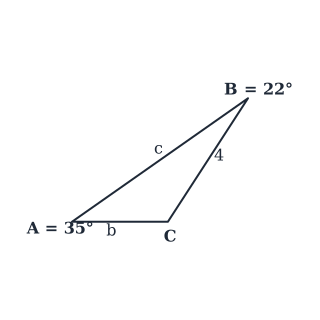
We can now take our quantities and put them into the sine rule. Here we don't need the last part, so we just remove it:
To get on its own, we can now just multiply by on both sides, which gives us
It can look a bit strange that the side length is actually shorter than , but that's just because of the sketch. The sketch isn't to scale, the numbers are.
The best thing about the sine rule is that we can use it on every triangle there is. It isn't tied to the right-angled triangle, the way Pythagoras' theorem is.
Common mistakes
- Pairing a side with the wrong angle. Side goes with angle , the corner opposite it. If you put over instead of , the whole thing is wrong from the first line. Check the pairs on the drawing before you write anything.
- Trying to use it without a known pair. The sine rule needs an angle and its own opposite side, plus one more quantity. Two angles alone, or two sides alone, aren't enough.
- Thinking it only works with a right angle. It's the other way round: the sine rule works on every triangle. It's the opp/adj/hyp formulas that are limited to right-angled triangles.
Related
- Trigonometry: sine, cosine and tangent
- The cosine rule, for three sides or two sides and the angle between them
- Sin, cos and tan in right-angled triangles
- Triangles: types, angles and properties, for the naming of corners and sides
Frequently asked questions
Read next
Want to get good at maths?
Mathara explains every topic step by step with videos, exercises and personal feedback.
👉 Get started for free