Guide
Sin, cos and tan in right-angled triangles
The three trigonometry formulas for right-angled triangles are not three things to memorise. They are the unit circle, scaled up by the hypotenuse. Here is how the sides are named and where the formulas come from.
What we use trigonometry for most is finding angles and lengths in triangles. We have some formulas we use for that, but let's look at where these formulas come from and how they came about, so we get a good understanding of when and how to use them. If you haven't read about the unit circle yet, start with what trigonometry is, because everything below comes from that one picture.
When do I use this?
You use these formulas when you have a right-angled triangle and you know an angle and one side, or two sides, and want the rest. They only work when there is a right angle in the triangle. For any other triangle you need the sine rule or the cosine rule.
Sine and cosine are side lengths
We go back to the triangle from the unit circle:
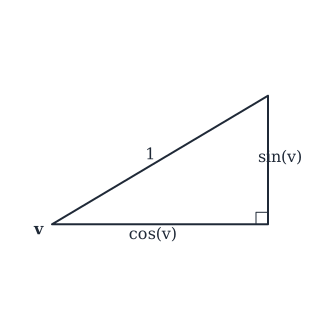
Here we can see that sine and cosine actually are side lengths in the triangle. The vertical side is , the horizontal side is , and the radius is the long side.
Naming the sides
In any right-angled triangle we have some names for the sides:
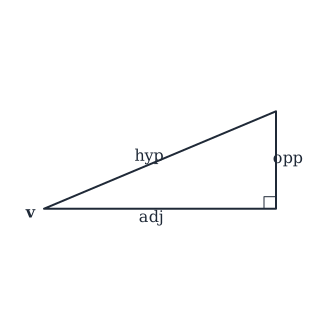
The side that sits next to the angle we're working with, we call the adjacent side, or adj. The side that sits opposite the angle, we call the opposite side, or opp. And the hypotenuse is just always the hypotenuse, hyp. Notice that adj and opp are named from the angle: pick a different angle, and the two shorter sides swap names.
So we can see, if we compare with the other triangle, that
But that's actually not quite true. It's only true if we're in the unit circle.
Why we have to scale by the hypotenuse
We know that sine and cosine can only be between and . So to find the right length of either the adjacent or the opposite side, we have to scale by the hypotenuse. In other words, we have to multiply the hypotenuse on. In the unit circle the radius, or the hypotenuse, is , so there:
Why do we have to multiply the radius on? If the radius was instead of , the cosine and sine values only make up a small part of the side lengths in the triangle. So we have to scale (multiply up) by the radius of the circle, so we get the right proportions and not just the proportions from the unit circle. The vertical side becomes and the horizontal side becomes .
If we look at it as a triangle, the radius is, after all, the hypotenuse, so we scale (multiply up) by the hypotenuse:
If we now get cosine and sine on their own, we get:
These two formulas we use a lot to find lengths in triangles. We only need to know two values to be able to work out the last one.
The formula with tangent
There's actually one more formula, which contains tangent. It looks like this:
It's fairly simple to arrive at. All we need is the definition of tangent, namely
We know that and (in the unit circle), so
In the UK the three formulas are often remembered as SOH CAH TOA: Sine is Opposite over Hypotenuse, Cosine is Adjacent over Hypotenuse, Tangent is Opposite over Adjacent. It's the same three lines as above, just packed into a word.
Using the formulas
Let's take a small example of using one of these formulas. If we had a triangle with an angle and its opposite side, we could find the adjacent side by using tangent. With an angle of degrees and an opposite side of :
and from there it's an equation to get the adjacent side on its own. The full walkthrough, with the numbers, is in the guide on finding a side with trigonometry.
Note that these formulas can only be used in right-angled triangles. For any other triangle we use some other formulas, which get their own guides.
Common mistakes
- "adj is the hypotenuse." No. The adjacent side is the shorter side next to the angle. The hypotenuse is the long side opposite the right angle, and it's always just the hypotenuse, whichever angle you work from.
- "sin(v) is the opposite side." Only in the unit circle, where the hypotenuse is . In any other triangle the opposite side is scaled up by the hypotenuse, which is exactly why the formula divides by hyp.
- Naming the sides from the wrong angle. Opposite and adjacent are always relative to the angle you're using. Find your angle first, then name the two shorter sides from it.
- Using the formulas in a triangle without a right angle. They don't apply there. Use the sine rule or the cosine rule.
Related
- Trigonometry: sine, cosine and tangent, the unit circle everything here comes from
- Finding a side with trigonometry, the worked example
- The sine rule and the cosine rule, for triangles without a right angle
- Pythagoras' theorem, the other tool for right-angled triangles
Frequently asked questions
Read next
Want to get good at maths?
Mathara explains every topic step by step with videos, exercises and personal feedback.
👉 Get started for free