Guide
Finding a side with trigonometry
When you know an angle and one side of a right-angled triangle, one of the three trigonometry formulas gives you another side. Here is the worked example from the book, step by step.
When we know an angle in a right-angled triangle and one of its sides, one of the three trigonometry formulas gives us another side. The procedure is short: name the sides, pick the formula, insert, rearrange. The hurdle is usually the rearranging step, when the side we want ends up under a fraction bar.
When do I use this?
You use this in a right-angled triangle when you know an angle (other than the right angle) and one side length, and want another side length. The three formulas we have are
where adj is the side next to the angle, opp is the side opposite the angle and hyp is the hypotenuse. Where these come from is explained in the guide on sin, cos and tan in right-angled triangles. We only need to know two values to be able to work out the last one.
Note that these formulas can only be used in right-angled triangles. For any other triangle we use the sine rule or the cosine rule.
The procedure
- Find the angle you're working with and name the sides from it: the side next to it is adj, the side across from it is opp, and the long side opposite the right angle is hyp.
- Pick the formula that contains the side you know and the side you want.
- Insert the angle and the known side.
- Rearrange for the side you want, exactly like getting on its own in an equation: do the opposite on both sides.
- Work it out on a calculator and round sensibly.
Worked example: finding the adjacent side with tangent
Let's take a small example. If we had a triangle with an angle and its opposite side, we can find the adjacent side by using tangent:
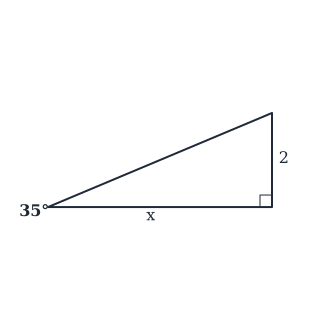
The angle is degrees, the opposite side is , and the side we want, , sits next to the angle, so it's the adjacent side. The formula that contains opp and adj is the one with tangent:
We insert what we know:
Now is under the fraction bar, so we have to get it on its own. We multiply both sides by , which lifts it out of the fraction, and then divide both sides by :
The side length will be about .
The value of is a value you look up, so this last line is a calculator line. Everything before it is just choosing the formula and rearranging.
Worked example: finding the opposite side with sine
The scaling idea behind the formulas says that in a triangle with hypotenuse , the side opposite the angle is . So if the hypotenuse is and the angle is again degrees, the opposite side is:
Here the unknown is on top, so rearranging is just multiplying both sides by :
Same procedure, and this time no fraction to climb out of.
Common mistakes
- Naming the sides from the wrong angle. Opposite and adjacent are always relative to the angle you're using. If you name them from the right angle, or from the other corner, you pick the wrong formula.
- Picking a formula that doesn't contain the side you want. You need the formula with the two sides you're dealing with, one known and one wanted. If neither of them appears in it, the formula can't help you.
- Forgetting to rearrange when the unknown is under the fraction bar. is not the answer yet. Multiply both sides by , then divide both sides by , and only then press the buttons.
- Using the formulas in a triangle without a right angle. They only work in right-angled triangles. For other triangles you need the sine rule or the cosine rule.
Related
- Trigonometry: sine, cosine and tangent
- Sin, cos and tan in right-angled triangles, where the formulas come from
- The sine rule and the cosine rule, for triangles without a right angle
- Pythagoras' theorem: finding the hypotenuse, when you know two sides and no angle
Frequently asked questions
Read next
Want to get good at maths?
Mathara explains every topic step by step with videos, exercises and personal feedback.
👉 Get started for free