Guide
The cosine rule
The cosine rule lets you find a side from two sides and the angle between them, or an angle from three sides, in any triangle. Here are the three versions and both worked examples from the book.
The cosine rules are, like the sine rule, a way we can find angles and side lengths in any triangle. There are three cosine rules, one for each of the sides , and . Picking the right one of the three is the only real decision. After that it's inserting numbers and, when it's an angle you want, one extra step at the end.
When do I use this?
The cosine rules can be used if we either have three side lengths in the triangle and want to find some angles, or if we have an angle and the two side lengths that don't belong to the angle, that is, the two sides next to it. If instead you know an angle together with its own opposite side, it's the sine rule you want. And if the triangle has a right angle, the short formulas from sin, cos and tan in right-angled triangles are enough.
The three cosine rules
The naming is the usual one: side is opposite corner , side opposite corner , side opposite corner . Notice that each rule contains exactly one angle, and it's the angle opposite the side on the left. That's how you pick: the version that contains the angle you know or want.
Worked example: finding a side
Let's look at an example:
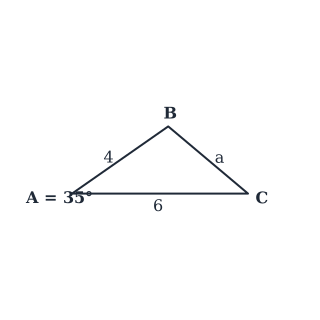
If we have the quantities as shown on the figure, and want to find the side length , we can use the first cosine rule, because that's the one with angle in it:
We insert our quantities in the formula. The side is opposite , so it's the side of length , and is the side of length :
That gives , and since we want and not , we take the square root:
So the side is about .
Worked example: finding an angle
We could also find an angle, if we had been given three lengths:
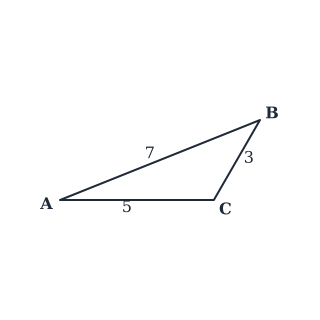
If we want to find angle on the figure above, we have to use the cosine rule that contains angle . We can see that the second cosine rule contains angle :
So we just insert the side lengths in their places in the cosine rule. Side is opposite , so , and the other two are and :
Now we have to solve this equation to find . We move everything except over to the other side, which gives
Now, to get completely on its own, we take the opposite of cos on both sides, which is :
(If this doesn't quite make sense yet, it doesn't matter. It's the button that undoes cos, and you can read more about that kind of button in the guide on inverse functions.)
The fraction works out to , and the calculator gives
So angle is about degrees.
Common mistakes
- Picking a version that doesn't contain your angle. Each cosine rule has exactly one angle in it, the one opposite the side on the left. To find or use angle , you need the version that starts with .
- Putting the sides in the wrong places. The side on the left is the one opposite the angle in the rule. In the angle example, because it's opposite , and the other two sides fill and .
- Using the cosine rule where the sine rule is simpler. If you know an angle and its own opposite side, the sine rule gets there in one line. The cosine rule is for three sides, or two sides and the angle between them.
- Stopping at cos(B). is not the angle. You still have to take on both sides to get itself.
Related
- Trigonometry: sine, cosine and tangent
- The sine rule, when you have an angle and its opposite side
- Sin, cos and tan in right-angled triangles
- Inverse functions, what the button is
Frequently asked questions
Read next
Want to get good at maths?
Mathara explains every topic step by step with videos, exercises and personal feedback.
👉 Get started for free