Guide
Inverse functions
Two functions are inverse when they cancel each other out. Squaring and square root, times 2 and divide by 2, plus 10 and minus 10. Every time you get x on its own in an equation, this is what you are using.
Two functions can be said to be inverse if they "cancel each other out". What we mean by that is that if we put them together, they dissolve each other. The surprising part is that you've been using inverse functions since the first equation you ever solved. This guide gives the thing you already do its name and its notation.
When do I use this?
Every time we get on its own in an equation, and every time a question asks for or . It leans on function notation and on composite functions, because "putting one function inside another" is exactly how we check that two functions are inverse.
Inverse functions in equation solving
Let's look at how we can use this property, that they dissolve each other, to solve equations. Look at two functions:
Even though they aren't quite inverse functions technically, we can still use them to dissolve each other. Take the equation
In this equation we have to get on its own, and so we have to get rid of the "squared". We can do that by taking the square root on both sides:
Then the square root cancels out the squared, that is, they dissolve each other. So we end up with
And if we want to work the square root of 25 out, we can do that:
So in this way we can use inverse functions to solve equations. And we actually do it all the time. Every time we have to get on its own in an equation, we use inverse functions. As we also saw in the article on equations, these functions are inverse too:
or
We multiply or divide on both sides of an equation really often, and that's actually inverse functions we've got hold of there too.
The notation f⁻¹(x)
Inverse functions are typically indicated with a little raised , but remember that this is not a power. It's just an indication that it's an inverse function:
The property that they dissolve each other can therefore be written like this:
So if we put the inverse function into the function itself, they cancel each other out and we end up with just . That's the "reverse process" the GCSE specification talks about: does something to , and undoes it.
Reading inverse functions off a graph
You can actually see on the graphs of 2 functions whether they're inverse or not. Inverse functions have the property that they mirror each other in the function , that is, a straight line where the y-value is equal to the x-value.
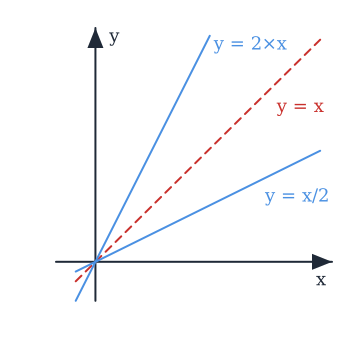
Here we've drawn one of the pairs from above, and , together with the red line . The two blue graphs mirror each other in the red line, and that's an indication that these functions are inverse.
Remember that not all functions have an inverse function.
A list of inverse functions
Here's a little list of some inverse functions that are good to know by heart:
The first two lines are the moves from equation solving, the third is squaring and rooting, and the last three are what you use in trigonometry to find an angle. Notice that they all sit on the same list. Plus and minus are just as much a pair of inverse functions as sine and .
On some calculators and computer tools the inverse trigonometric functions are written as arcsin, arccos and arctan. Same functions, different name on the button.
In short: inverse functions and equation solving
When we solve equations, we use inverse functions all the time. If we have something in minus, we use plus to remove it, and so on. That's actually what equation solving is: a lot of inverse functions. If we just have our inverse functions under control, equation solving gets a whole lot easier.
Common mistakes
- "f⁻¹(x) means 1 divided by f(x)." No. The little raised is not a power. It's just an indication that it's the inverse function.
- "Square root and squaring are perfect inverses." Not quite, technically. But we can still use them to dissolve each other when we solve .
- "Every function has an inverse." Remember that not all functions have an inverse function.
- "Inverse functions are an advanced topic I've never used." You've used them in every equation. Taking 10 away to remove a is an inverse function.
- "sin⁻¹ and arcsin are different things." They're the same function. Some tools just write arcsin.
Related
Frequently asked questions
Read next
Want to get good at maths?
Mathara explains every topic step by step with videos, exercises and personal feedback.
👉 Get started for free