Guide
Function notation: what f(x) means
f(x) is just another name for y. The f names the function and the bracket shows which variable it depends on, which is why f(3) is such a handy way to say the function value when x is 3.
There are many ways to write a function, and is the one that turns up all over the GCSE papers. It means exactly the same as . The hurdle is that it looks like a multiplication, and it isn't one.
When do I use this?
Whenever a question is written with instead of , and especially when it asks you to "find " or "work out ". It's also the notation that composite functions and inverse functions are built on. If the word function is still new, start with What is a function?
Two ways of writing the same function
There are many ways to write functions. You probably already know , which is the one we typically use, but there are also many other names we can use.
When we write, for example,
it just means that the y-value is found by multiplying the x-value by 2 and adding 5 afterwards. Fairly simple. Another way, which we also use a lot, is to write instead of :
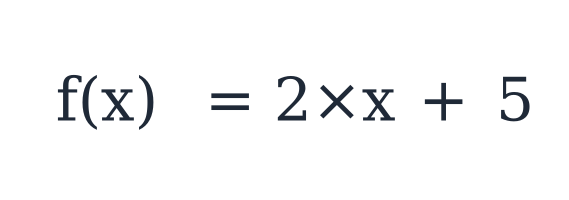
It means exactly the same. is really just that, what we name our function, and with the bracket we show which variable our function depends on. So tells us a bit more than does, because lets us see which variable the function depends on.
Finding function values
has its advantages, for example when we have to find the function value, that is, the y-value, for different x-values.
Let's take the function
If we had to find the y-value when , we'd of course just put 1 in x's place, but we can actually write
Here we've written , which means that we're finding the function value when is 1. So it's good to use , because we can see which x-value we're finding the y-value for. In our example becomes
What it says is that the function value when is 7.
If we got the question "Find ", we'd have to find the function value (the y-value) when :
So it's often better to use than . The bracket carries the x-value with it, and the answer can never get separated from the question.
Naming more than one function
We can also call functions something other than . We might have a question with 2 functions. Then we can't use the same name, and we have to call the second one something else. We always carry on through the alphabet and name our function with the next letter. After we'd name the new function
the next function is then , and so on.
Common mistakes
- "f(x) means f multiplied by x." No. is only the name we've given the function, and the bracket shows which variable the function depends on. is the function value when is 3, not .
- " means that x is 11." It's the other way round. The 3 is the x-value we put in, and 11 is the y-value that came out.
Related
Frequently asked questions
Read next
Want to get good at maths?
Mathara explains every topic step by step with videos, exercises and personal feedback.
👉 Get started for free