Guide
Composite functions
Composite functions are exactly what the name says: we put one function into another. Take the whole of g(x) and put it in x's place in f(x), and you have f(g(x)).
Composite functions are, as the name says a bit, when we put functions together. By "put together" we mean that we put one function into another. The hurdle is the order: putting into is not the same as putting into .
When do I use this?
Whenever a question gives you two functions and asks for , , or something similar. You need function notation to be second nature first, because a composite function is nothing more than function notation used twice.
The procedure
Let's start with an example. I have two functions:
If I put into , I just have to take the whole function and put it in x's place in the other function, , like this:
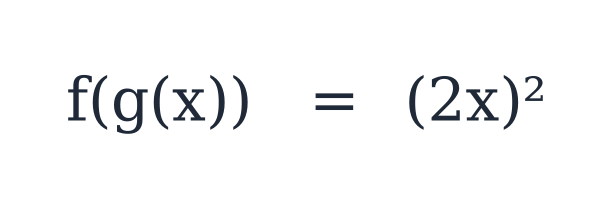
What we've done is just to put in x's place in . If we did it the other way round, that is, put into , it would look like this:
These are composite functions. We just stuff one function into the other function.
How we write it
When we write composite functions, we do it like this:
This says that we've put into . The other way round would be
which means that we've put into . We say it as "f of g of x", or the other way round: "g of f of x".
The GCSE papers use a shorthand for exactly the same thing:
So when you see , read it as : is the inner function, is the outer one, and you do the inner one first. It's just the brackets left out to save ink.
Worked example
Let's try taking one more example. We have the functions
where is the same sine you know from trigonometry.
If we had to find , that is, when we put into , we get
because we've just put in x's place in .
If we do it the other way, that is, find , we have to put in x's place in , like this:
Two different functions from the same two ingredients. That's the whole point of keeping the order straight.
Common mistakes
- "f(g(x)) is the same as g(f(x))." It isn't. In our first example while . Which function is inside decides everything.
- "I only put part of the inner function in." You have to take the whole of the inner function and put all of it in x's place. Putting into gives , brackets and all.
- "fg(x) means f times g." It means : first, then . It's function notation, not multiplication.
Related
Frequently asked questions
Read next
Want to get good at maths?
Mathara explains every topic step by step with videos, exercises and personal feedback.
👉 Get started for free