Guide
Pythagoras' theorem: finding the hypotenuse
When you know the two shorter sides of a right-angled triangle, Pythagoras' theorem gives you the hypotenuse. Insert the values, add the squares, and remember the square root at the end.
With Pythagoras' theorem we can find one of the side lengths in a right-angled triangle, if we have the other two. In this guide we have the two shorter sides and want the long side, the hypotenuse. The formula is built for exactly this case, so all we have to do is insert our values. The one place people slip is the very last step, where a square root has to be taken.
When do I use this?
You use this when you have a right-angled triangle, you know the two sides that sit closest to the right angle, and you want the side opposite the right angle. That side is the hypotenuse, and in the formula it is :
If the triangle does not have a right angle, this does not apply. And if it is one of the shorter sides you are missing, the formula has to be turned around first, which is its own guide about finding a shorter side. What the three letters mean is explained in Pythagoras' theorem.
The procedure
- Insert the two shorter sides in the formula in place of and .
- Work out the two squares. A number squared is just the number multiplied by itself.
- Add them. Now you have .
- Take the square root on both sides, so you get and not .
- Work out the square root. That is the hypotenuse.
Worked example
Let's take an example:
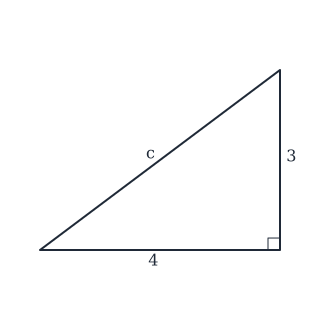
Here we have a right-angled triangle where one shorter side is and the other is . But what is ?
Here we can use Pythagoras' theorem. All we have to do is insert our values in the formula:
squared is, after all, the same as , which is , and squared is just , which is . So:
plus is :
Here we need to pay attention to something. We have got to be , and not just . So we have to remove this squared, because we want and not . We do that by taking the square root:
We have to remember to do it on both sides. (If this thing with the square root did not quite make sense, it is a good idea to read the guide on square roots and cube roots.) Now we just have to work out the square root of , which is . So:
So the hypotenuse, the last side length in the triangle, is .
We can check that it fits: is longer than both and , and the hypotenuse is always the long side. If the number you get is shorter than one of the sides you started with, something has gone wrong along the way.
Common mistakes
- Stopping at . is , not . The hypotenuse is . This is the step to slow down at: when you see $c^2 = $ something, the very next line is a square root on both sides.
- Adding the sides instead of the squares. , but the hypotenuse is . It is the squared side lengths that add up. Insert the values, square them, and only then add.
- Using the formula in a triangle without a right angle. Pythagoras' theorem only works in right-angled triangles. For other triangles you need the sine rule or the cosine rule from trigonometry.
- Putting the hypotenuse in as or . is always the side opposite the right angle. If that is the side you already know, you are not finding the hypotenuse, you are finding a shorter side, and the formula has to be rearranged first.
Related
- Pythagoras' theorem, the glossary entry with the names of the sides
- Pythagoras' theorem: finding a shorter side, when it is or that is missing
- Square roots and cube roots, for the last step
Frequently asked questions
Read next
Want to get good at maths?
Mathara explains every topic step by step with videos, exercises and personal feedback.
👉 Get started for free