Guide
Pythagoras' theorem: finding a shorter side
Sometimes you know the hypotenuse and one shorter side, and it is the other shorter side you are missing. Then you rearrange Pythagoras' theorem for it first, exactly like getting x on its own in an equation.
Sometimes we find that it is not we have to find, but maybe or when we use Pythagoras' theorem. The formula is built for finding the hypotenuse, so when we want one of the shorter sides instead, we have to move things around in it first. That one extra step is the whole difference from the usual case.
When do I use this?
You use this when you have a right-angled triangle, you know the hypotenuse (the side opposite the right angle) and one of the shorter sides, and it is the other shorter side you are missing. If it is the hypotenuse you are missing, the formula works as it stands, and that case is in the guide on finding the hypotenuse.
It could look like this:
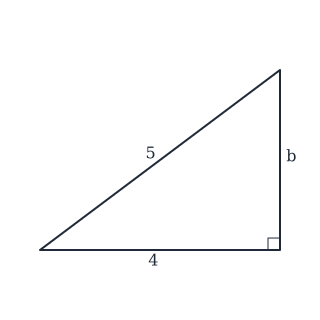
Here we actually have and , and have to find .
The procedure
Our formula, as we know, looks like this:
It is made to find , because stands alone. So we have to move things around a bit so it is that is on its own.
If we look at it as an equation, we can, after all, get on its own by simply subtracting on both sides:
Smart, isn't it? Now we suddenly have Pythagoras' theorem, but rearranged for instead. All we did was get on its own in Pythagoras' theorem, exactly like we get on its own in an equation. From here the steps are the same as always:
- Insert the hypotenuse in place of and the known shorter side in place of .
- Work out the two squares and subtract.
- Take the square root on both sides to get and not .
Worked example
Now we can insert our values in the rearranged formula:
That becomes:
So is , but we are not interested in , only . So we remove the squared again, and we do that by taking the square root:
So the side length is .
We can check this is right, because we know the triangle from the guide on finding the hypotenuse: the sides and gave a hypotenuse of . Here we went the other way, from and back to , and landed on the same triangle.
When we do not have to find , but or instead, we can simply rearrange for the side length, exactly like we get on its own in an equation, and then insert our values, as we normally do.
Common mistakes
- Adding the squares as usual. If you add you get , and is longer than the hypotenuse, which cannot be right. When a shorter side is missing, the formula has to be rearranged first: .
- Subtracting the wrong way round. It is always the hypotenuse squared minus the known shorter side squared. The hypotenuse is the long side, so is the biggest number and comes first.
- Forgetting the square root. is not the answer. The side is . Same slowdown point as when you find the hypotenuse.
- Mixing up which side is the hypotenuse. The hypotenuse is the side opposite the right angle. Find it on the drawing before you put anything into the formula, because it is the only side that may take the place of .
Related
- Pythagoras' theorem, the glossary entry
- Pythagoras' theorem: finding the hypotenuse, the case where the formula works as it stands
- How to solve linear equations, the rearranging move this guide borrows
Frequently asked questions
Read next
Want to get good at maths?
Mathara explains every topic step by step with videos, exercises and personal feedback.
👉 Get started for free