Maths dictionary
Triangles: types, angles and properties
A triangle has three corners, three angles that always add up to 180 degrees, and a handful of names worth knowing. Here are the types of triangle, the special lines inside them, and the two circles that belong to every triangle.
A triangle is called a triangle because it has three corners. And because there are three corners, there are also three angles, and together they always make 180 degrees. We call the total of the angles the angle sum, and in a triangle the angle sum is 180 degrees. Every time, whatever the triangle looks like.
That one fact is the thing to carry with you. Almost everything else about triangles is either a name for a particular kind of triangle, or a formula you plug the triangle's measurements into.
How we name the corners and sides
When we name the angles and the side lengths, the angles usually get capital letters, and the side opposite each angle gets the same letter in lower case.
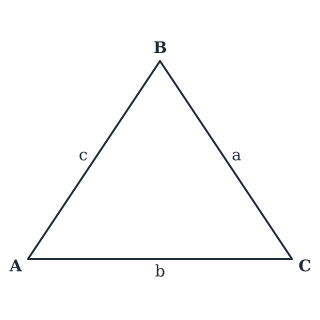
So side sits opposite corner , side sits opposite corner , and side sits opposite corner . It's a small convention, but it saves a lot of confusion later, because you can always tell which side a question is talking about.
The types of triangle
We sort triangles into a few groups, and these are the most important ones.
Right-angled triangle
A right-angled triangle contains an angle that is 90 degrees. When an angle is 90 degrees we say that it is right, and that's where the name comes from.
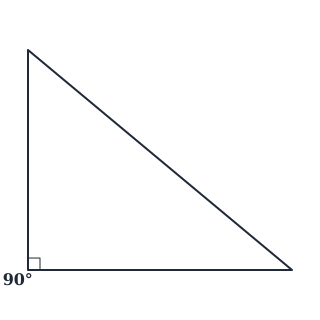
Since the angle sum in a triangle has to be 180, the two remaining angles are forced to make 90 degrees between them, because
The right-angled triangle is the one you'll meet most often, because Pythagoras' theorem and trigonometry both start from it.
Obtuse-angled triangle
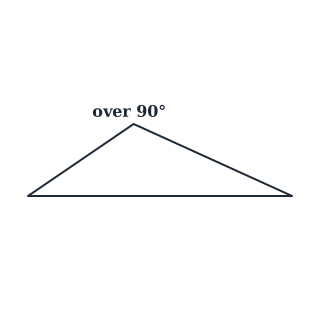
An obtuse angle is an angle that is bigger than 90 degrees. An obtuse-angled triangle contains one angle like that. Here too the angle sum has to be 180, so the other two angles are small.
Acute-angled triangle
An acute-angled triangle has no right angles and no obtuse angles. That means all the angles are under 90 degrees. The angles are acute, which just means they're under 90.
Isosceles triangle
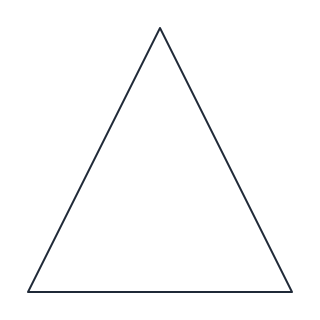
In an isosceles triangle, 2 of the sides are equally long. That means 2 of the angles are also equally big.
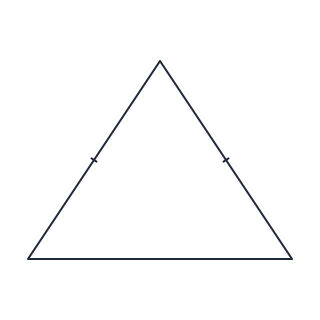
The small strokes on the figure mean that things are equal. The two sides with a stroke through them are equally long. The two equal angles are marked with 2 strokes each, so we can tell the angle marks from the side marks. It could easily have been the other way round, it's just so we can see what is equally big.
Equilateral triangle
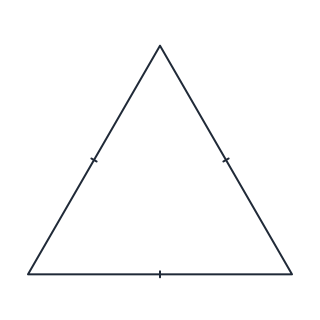
Here all 3 sides are equally long, which means all 3 angles are also equally big. If all the angles have to be equal, they must be 60 degrees each, because
Congruent, equiangular and similar triangles
Triangles can also be compared with each other.
When two triangles are congruent, it means they are completely identical: the same angles and the same side lengths.
When two triangles are equiangular, it means they have the same angles. Notice that they don't need to have the same side lengths, only the same angles. They can easily be different sizes but still have the same angles.
When two triangles are similar, it means their angles are equal pair by pair, but they can easily be different sizes. So when 2 triangles are equiangular, they are also similar. The useful part is that the sides of similar triangles are in the same ratio, and that gets its own guide about similar triangles.
The three special lines in a triangle
There are three lines we're often asked to draw in a triangle, and it matters that we can tell them apart.
The perpendicular bisector is the line that stands perpendicular on one of the sides of the triangle and cuts that side in the middle.
A median goes from a corner to the middle of the opposite side.
The angle bisector is, as the name says, the line that splits an angle into 2 equal angles.
We often get questions where we have to draw all three, so it's worth knowing the difference. Especially the median and the perpendicular bisector, because they look a lot like each other: one goes through the middle of a side and the other goes to the middle of a side, but only the perpendicular bisector has to stand at a right angle.
The inscribed and circumscribed circle
Every triangle has two circles that belong to it.
The inscribed circle is a circle drawn inside the triangle that just touches each side once. You find the centre of the inscribed circle where all 3 angle bisectors cross.
The circumscribed circle is the circle that touches all the corners of the triangle. You find its centre where all 3 perpendicular bisectors cross.
Area and perimeter
The area of any triangle comes from one formula, half the height times the base, and the perimeter is just all the side lengths added together. The full walkthrough is in the guide how to find the area and perimeter of a triangle.
Common misunderstandings
- "The angle sum depends on which triangle it is." No. Big or small, pointy or flat, the three angles of a triangle always add up to 180 degrees. That's why we can say that the two remaining angles in a right-angled triangle make 90 between them without measuring anything.
- "Similar and congruent mean the same thing." They don't. Congruent triangles have the same angles and the same side lengths. Similar triangles have the same angles, but the sides can be scaled up or down.
- "If two triangles have the same angles, they must be the same size." No. Same angles only tells you the shape. The triangles can be as different in size as you like.
- "I need all three sides to find the area of a triangle." You don't. You need the height and the base, and the height has to be measured straight down onto the base, at a right angle.
- "The median and the perpendicular bisector are the same line." They look alike, but the median goes from a corner to the middle of the opposite side, while the perpendicular bisector goes through the middle of a side at a right angle to it.
Related guides
Guides on this topic
How to find the area and perimeter of a triangle
One formula covers every triangle: half the height times the base. The only thing to get right is the height, which has to stand at a right angle to the base.
Similar triangles and the ratio of their sides
Two triangles with the same angles are the same shape, just scaled. That gives you one ratio for all their sides, and with it you can find any side you're missing.
The angles in a triangle add up to 180 degrees
Three corners, three angles, and together they always make 180 degrees. Once you know that, a missing angle in a triangle is just a subtraction.
Frequently asked questions
Read next
Want to get good at maths?
Mathara explains every topic step by step with videos, exercises and personal feedback.
👉 Get started for free