Guide
Similar triangles and the ratio of their sides
Two triangles with the same angles are the same shape, just scaled. That gives you one ratio for all their sides, and with it you can find any side you're missing.
Two triangles can have exactly the same shape without being the same size. When that happens we call them similar, and it comes with a very useful property: the ratio between their side lengths is the same for every pair of sides. This guide is about telling the three kinds of "the same" apart, and about using that ratio to find a missing side.
When do I use this?
Whenever a question shows you two triangles with the same angles and asks for a length in one of them. The idea is the same one as the scale between two drawings of the same thing, where one is a scaled version of the other. That's covered in scale and scale drawings.
Congruent, equiangular and similar
There are three words here, and they mean three different things.
When two triangles are congruent, it means they are completely identical. So the same angles and the same side lengths.
When two triangles are equiangular, it means they have the same angles. Notice that they don't need to have the same side lengths, only the same angles. They can easily have different sizes but the same angles.
When two triangles are similar, it means they have equal angles pair by pair, but they can easily have different sizes. So when 2 triangles are equiangular, they are also similar.
The ratio of the sides
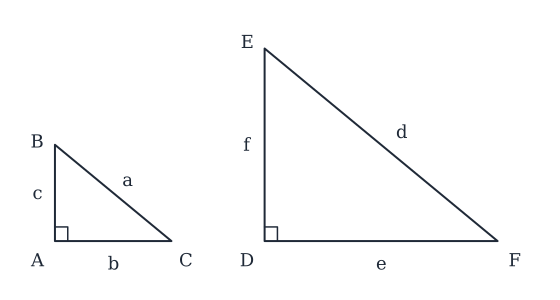
There are actually some important properties when 2 triangles are equiangular. If 2 triangles have equal angles pair by pair, like in the figure, we can actually enlarge one of them so that it becomes the other. In other words, if we make the one figure some number of times bigger, it becomes exactly like the other one. So we can multiply all the side lengths in the one triangle by the same number, and they become as big as in the other.
That also means that the ratio between the side lengths of the 2 triangles is the same:
What it says is that the ratio between the side lengths and is exactly the same ratio as between and , and between and . It really just means that we can multiply all the side lengths in the one triangle by the same number to make them as big as in the other triangle.
Notice how the letters pair up. Side matches side , matches , and matches , because they sit opposite the matching angles. Getting the pairs right is the whole job.
Worked examples
Finding the number we scale by
Say the small triangle in the figure has and the large one has . Those two sides match, so
The large triangle is 3 times bigger. Every side in it is 3 times the matching side in the small one.
Finding a missing side
Same two triangles. If in the small triangle, then the matching side in the large triangle is
We can check this is right, because the ratio has to be the same for every pair, and , just like .
Going the other way
If instead we knew in the large triangle and wanted in the small one, we'd divide by 3 instead of multiplying:
The number we scale by is the same, we're just using it in the other direction, from the large triangle down to the small one.
Common mistakes
- "Similar means the same triangle." No, that's congruent. Similar triangles have the same angles, but the side lengths can be different. Congruent triangles have the same angles and the same side lengths.
- "If the angles are the same, the sides must be the same too." They don't have to be. Same angles only fixes the shape. The size can be anything, which is exactly why we need the ratio.
- "I can pair up any two sides to get the ratio." Only matching sides go together, the ones opposite matching angles. goes with , with , with . Pair them wrong and the ratio comes out wrong.
Related
The names and types of triangle are in Triangles: types, angles and properties. The fact that makes equiangular triangles possible in the first place, that the angles always make 180, is in the angles in a triangle add up to 180 degrees. And once you have all the sides, the area of a triangle is the next step.
Frequently asked questions
Read next
Want to get good at maths?
Mathara explains every topic step by step with videos, exercises and personal feedback.
👉 Get started for free