Maths dictionary
Scale and scale drawings
Real things are often too big for a piece of paper, so we scale them down and write the scale as 1 : x. Here is what the two numbers mean, and which one is the drawing.
Out in the real world, things can get very big, so we have to make them smaller to get them down on paper, so that we can make models of the big things. For example, a world map isn't full size, because it's a bit hard to have the whole world hanging on the wall at home. So we have to scale it down, that is, make it some number of times smaller than it is in reality.
How we write a scale
The relationship between the real size and what we have on the paper we write like this:
If what we have on the paper should be half as big as it is in reality, the scale would look like this:
This means that 1 on the paper is 2 in reality. That could be centimetres, metres or kilometres. It depends entirely on what the question says.
A map scale
If we have been given the scale
(in cm), it means that 1 cm on the paper is 10000 cm in reality. How you turn a length you measure on the map into the real distance gets its own guide: how to use a map scale.
Making small things bigger
We can also describe really small things in reality. If, for example, we had to make a model of a bacterium, we'd have to make it bigger than it is in reality. So we might make the drawing 50000 times bigger. That we would write as
If it was given in mm, that would mean that 50000 mm on the paper is 1 mm in reality.
A little rule to remember
A good little rule to remember is that the drawing always comes first:
So in 1 : 2 the paper is the small one, and in 50000 : 1 the paper is the big one.
The scale between two figures
Another example could be the scale between 2 figures that have the same shape but aren't the same size:
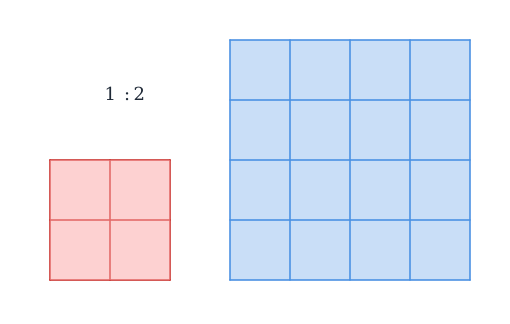
When we look at the scale between 2 figures, we look at how many times longer the big figure's side lengths are than the small one's side lengths. Here we can see that the side lengths of the blue square are 2 times longer than the red square's side lengths. So the scale is 1 : 2.
Two figures like these, same shape but not the same size, are what we call similar. The same idea comes back with similar triangles, where the sides of the two triangles are in a fixed ratio too.
Common misunderstandings
- "1 : 2 just means half size, or double size, whichever." The direction matters. With 1 : 2 the paper is the small side: 1 on the paper is 2 in reality. With 2 : 1 the paper is the big side: 2 on the paper is 1 in reality. Read the drawing side first.
- "The scale tells you which unit to use." It doesn't. 1 : 2 could be centimetres, metres or kilometres. The question decides the unit, and it's the same unit on both sides of the colon.
Related guides
Guides on this topic
Frequently asked questions
Read next
Want to get good at maths?
Mathara explains every topic step by step with videos, exercises and personal feedback.
👉 Get started for free