Guide
The angles in a triangle add up to 180 degrees
Three corners, three angles, and together they always make 180 degrees. Once you know that, a missing angle in a triangle is just a subtraction.
A triangle has three corners, so it has three angles, and together they always give 180 degrees. We call the total of the angles the angle sum, and in a triangle it is 180 degrees. This guide is about using that fact to find an angle you haven't been told.
When do I use this?
Whenever a question gives you some of the angles in a triangle and asks for the last one. It doesn't matter what the triangle looks like. The angle sum is a property of triangles in general, not of the particular triangle in front of you, so you can use it without measuring anything.
The procedure
There's really only one move.
- Add up the angles you already know.
- Take that total away from 180.
- What's left is the missing angle.
Let's say a triangle has angles of 70 and 45 degrees. Then the last angle is
So the third angle is 65 degrees. We can check it's right, because .
Worked examples
The right-angled triangle
A right-angled triangle contains an angle that is 90 degrees.
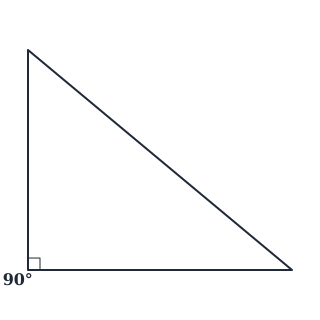
Since the angle sum has to be 180, the 2 remaining angles are forced to make 90 degrees together, because
That means we only need one more angle to know them all. If one of the other angles is 35 degrees, the last one is
Or, a bit quicker, , because the two small angles share the remaining 90.
The equilateral triangle
In an equilateral triangle all 3 sides are equally long, which means all 3 angles are also equally big. If all the angles have to be equal, they must be 60 degrees each, because
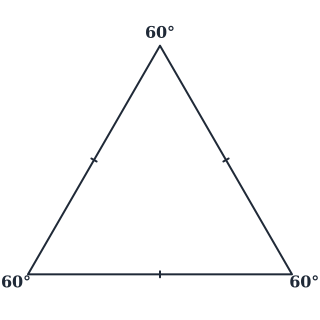
So in an equilateral triangle you never have to calculate anything. Every angle is 60.
The isosceles triangle
In an isosceles triangle 2 of the sides are equally long, and that means 2 of the angles are also equally big. So if we know the odd one out, the other two share what's left.
Say the odd angle is 40 degrees. Then the two equal angles share
and each of them is degrees. Check: .
Common mistakes
- "A bigger triangle has a bigger angle sum." No. The angle sum is 180 degrees for every triangle, however big or small it's drawn. Scaling a triangle up changes the sides, not the angles.
- "A right-angled triangle can have another angle of 90 degrees." It can't. One angle is already 90, so the other two have to make 90 between them, which means each of them is under 90.
- "In an isosceles triangle any two angles can be the equal ones." The two equal angles sit opposite the two equal sides. That's the pair that shares what's left after you take away the odd angle.
Related
The names of all the types of triangle are in Triangles: types, angles and properties. Once the angles are sorted, the next things you'll usually need are the area of a triangle and, when two triangles share their angles, the ratios in similar triangles.
Frequently asked questions
Read next
Want to get good at maths?
Mathara explains every topic step by step with videos, exercises and personal feedback.
👉 Get started for free