Guide
The equation of a circle
A circle is all the points that sit the same distance, the radius, from the centre. Put that into Pythagoras and you get the equation of a circle. Here is where it comes from, the GCSE case with the centre at the origin, and how to read the centre and radius off an equation.
The equation of a circle is a way to describe a circle in a coordinate system. When we draw a circle in a coordinate system, there are three important things: the centre of the circle, the radius of the circle, and a point on the circle itself (its circumference). With those three we can write one equation that every point on the circle satisfies.
When do I use this?
When a question gives you a circle drawn on axes, or its equation, and asks for the radius, or whether a point lies on the circle. At GCSE the centre is always at the origin, , but the equation is easiest to understand if we start with a circle anywhere in the plane, the way I do it in my Danish notes, and then move the centre to the origin. This is part of coordinate geometry, and the words centre, radius and circumference are the ones from circles.
The equation
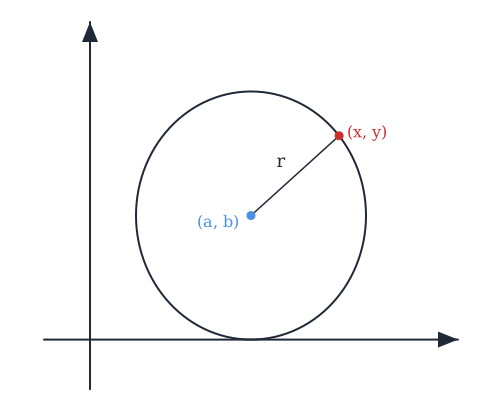
Here the circle has a centre, which we give the coordinates . On top of that we have the circle's radius, which we mark with , and finally we have any point on the circle, which we give the coordinates . The equation of the circle is then:
Remember here that the point is the centre, is any point on the circle, and is the radius. What the equation actually says is that the distance from the centre to every point on the circle must be exactly the same. Otherwise it wouldn't be a circle. So the point has to satisfy the equation if it's going to lie on the circle.
Centre at the origin
When the centre is at the origin, and , so the brackets simplify and the equation becomes
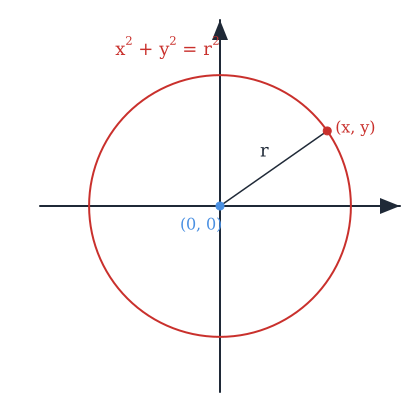
This is the version you meet at GCSE. The circle , say, has , so its radius is . And because every point on the circle has to satisfy the equation, we can quickly check whether a point is on the circle by putting it in. Is on the circle? , and is exactly , so yes it is. A point like gives , which is bigger than , so that point lies outside the circle.
Why does the equation look like that?
You may already see that the equation looks like Pythagoras' theorem, or like the distance formula from the guide midpoint and distance between two points, and you're completely right. It actually comes from there.
We want a way of seeing whether a point really is part of the circle. A circle is really just a lot of points that all have the same distance to one particular point, which we call the centre. So the goal is to set up an equation that describes that all the points have the same distance to the centre.
We start with the radius. If a point lies on the circle, the distance from the centre to the point is the radius. We can describe that with Pythagoras, because we can draw a right-angled triangle with the radius as the hypotenuse:
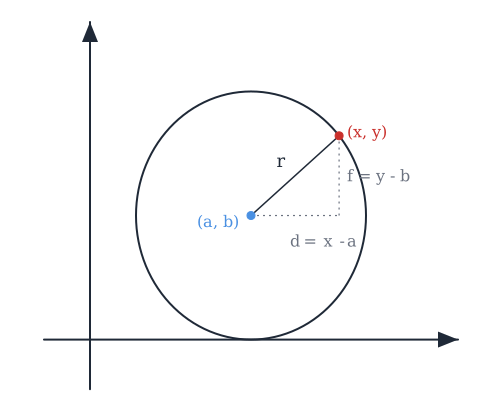
We can write Pythagoras' theorem for the triangle:
Normally we use and in Pythagoras' theorem, but here on the figure we've called the two shorter sides and , because and are already taken by the centre.
If a point is going to lie on the circle, the point has to "fulfil" Pythagoras' theorem: squared plus squared must equal the radius squared. If the point wasn't on the circle but further out, then would suddenly be bigger than , and the point would lie outside the circle. Our goal is to describe the points that lie on the circle.
Now we can replace and with something else. We can see that is actually the difference between the x-value of the point and the x-value of the centre. At the same time, is the difference between the y-value of the point and the y-value of the centre:
So instead of we can write
And that's how we arrive at the equation of a circle. It's a kind of collection of all the points that lie the same distance from the centre. All those points are what makes up the circle. That's also why we can find out whether a point is part of the circle by putting the point into the equation and seeing whether it holds.
Reading the centre and radius off an equation
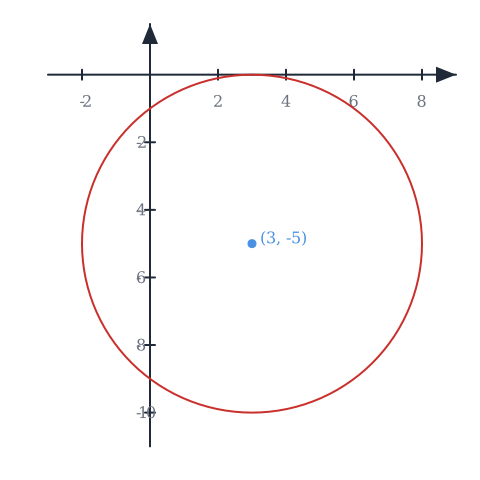
Let's look at how the equation of a particular circle can look. Say we had
It can be a bit tricky to read off here, so let's see how it's done. Here .
But why is equal to and not just , when it says in the equation? Because in the original equation of the circle there's a minus sign. That minus sign is part of the equation itself. So if is , we get
which is , exactly what stands in our example. When you try to find and , the coordinates of the centre, you have to keep an eye on the signs. In the same way, in our example, because there the minus sign from the equation is still there.
The radius of our example is , because we have in the equation and here it says . So the circle looks like this:
Let's take one more example. A circle has the equation
If we start with again, we can see that , because when we write it in the form of the circle equation, with the minus, we get . Minus and minus give plus, so we keep the "structure" of the equation, just adapted to our example. When we read off the b-value, it's already written in the form of the equation, so is simply .
The radius is written a bit differently here, because we're used to having the radius squared, . In this example it's been worked out, or "simplified". We had something squared that has become . We can find it by taking the square root of , which gives . You can also say that . So the radius is .
For a circle with its centre at the origin the same reading applies: in the number on the right is , so , not .
Common mistakes
- Reading the sign of the centre straight off the bracket. means , but means , because the equation has a minus built in and is .
- Taking the number on the right as the radius. The right-hand side is . If it says , the radius is .
- Forgetting that the equation is a test. A point is on the circle only if putting it in makes the two sides equal. If the left-hand side comes out bigger than , the point is outside the circle.
Related
Frequently asked questions
Read next
Want to get good at maths?
Mathara explains every topic step by step with videos, exercises and personal feedback.
👉 Get started for free