Guide
What is a factorial?
A factorial is a short way of writing a long chain of multiplications down to 1. Five children in a row can stand in 5 × 4 × 3 × 2 × 1 = 120 ways, and we write that as 5!.
A factorial is a short way of writing a chain of multiplications that goes all the way down to 1, and we write it with an exclamation mark, like . The hurdle is that the sign looks like a new operation you have to learn, when it's actually just an abbreviation.
When do I use this?
Factorials turn up when we count the number of ways to put things in order. In Counting outcomes we used the tree diagram and the product rule to count combinations. When the things we combine are the same items lined up in different orders, the multiplication is always the same chain, and that chain is what the factorial writes for us.
The procedure
- Ask how many items can go in the first place. Say there are 5.
- The same item can't be in two places at once, so 4 are left for the second place, then 3 for the third, and so on down to 1.
- Multiply the chain: .
- Write it the short way: . The exclamation mark means multiply all the numbers together, all the way down to 1.
Worked example: five children in a row
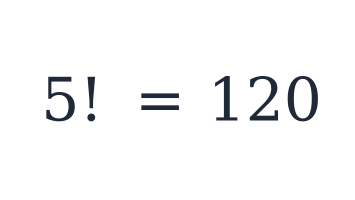
Say we have 5 children we need to line up in a row, and we want to find out how many different ways the children can stand. The same child can't stand in 2 places at the same time, so to start with, 5 children can stand in 1st place, 4 children in 2nd place, 3 children in 3rd place, and so on. We therefore find the number of different line-ups by saying
Worked example: shuffling a deck of cards
Another example could be a deck of cards. How many different ways can the deck be shuffled? There are 52 cards, so we say
and so on. Since this gets very long, we have a way of writing it more easily. Namely the factorial. This long chain we can simply write as
We just put a "!" after the number. It indicates that we multiply all the numbers together, all the way down to 1. An example could be :
So the 5 children can stand in the row in 120 different ways.
The general version
When we work with orderings, the factorial is something we use often. More generally we say that the factorial is defined as
Here is just the number you choose. All it says is that you make the number 1 smaller each time, and keep multiplying until you get to 1.
Common mistakes
- "The factorial is a new operation with its own rules." It isn't. It's just a shorter way of writing a chain of multiplications, made because the long version, like the one for 52 cards, gets very long.
- "I stopped the chain early." The chain goes all the way down to 1. isn't ; you keep going with .
Related
Factorials are the ordering case of the product rule for counting, and the whole topic starts in Counting outcomes.
Frequently asked questions
Read next
Want to get good at maths?
Mathara explains every topic step by step with videos, exercises and personal feedback.
👉 Get started for free