Guide
The product rule for counting
3 kinds of bread, 2 kinds of meat, 4 kinds of cheese. Both bread and meat and cheese means multiply: 24 sandwiches. Only one item in total means add: 9 choices. That is the whole rule.
The product rule says that when we pick one thing from each of several sets, we multiply the number of options together. The hurdle is that the rule has a twin, the addition rule, and choosing the right one depends on reading the situation correctly.
When do I use this?
In Counting outcomes we counted 27 ice creams by drawing a tree diagram. The product rule is the shortcut for the same thing: it gives the number of complete paths in the tree without drawing them. We call it the multiplication rule, and it's used exactly like the multiplication rule in probability. The question to ask is whether we're in a both-and situation or an either-or situation.
The procedure
- Write down the sets you choose from, and how many options are in each.
- Ask: do I take one thing from every set (both this and that and that)? Then it's a both-and situation, and you multiply the numbers of options.
- Or do I take just one thing in total, from one set or another (either this or that)? Then it's an either-or situation, and you add the numbers of options.
- Calculate. If you're unsure, a small tree diagram will confirm the count.
Worked example: the sandwich (both-and)
We use the multiplication rule when we have a both-and situation. If we want to buy a sandwich where we can choose between 3 kinds of bread, 2 kinds of meat and 4 kinds of cheese, how many ways can we put it together? We want both bread and meat and cheese. So this is a both-and situation. The multiplication rule therefore says that we can just multiply all our options together:
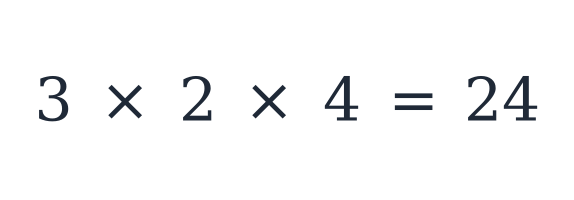
We could easily have used the tree diagram here too, but it's a bit faster to use the multiplication rule. It's important to remember that we only use the multiplication rule when we have a both-and situation.
Worked example: just one item (either-or)
What if we only wanted to choose one of our items? Just 1 thing out of our 3 kinds of bread, 2 kinds of meat and 4 kinds of cheese. Here we have to use the addition rule.
We use the addition rule when we have either-or situations, that is, where we either choose something from one set or something else from another set. So if we may only choose 1 thing from our 3 breads, 2 meats and 4 cheeses. It becomes a very strange sandwich, because we get either bread, or cheese, or meat, but let's leave that. The addition rule says that we just add all our options together. We can either choose bread, or meat, or cheese:
We add all the options together and see that we can choose in 9 different ways.
Both-and or either-or
Put the two side by side and the difference is the word in the middle:
- Bread and meat and cheese, one from each set: multiply, .
- Bread or meat or cheese, one item in total: add, .
The same reading, both-and against either-or, is the one we use to pick between multiplying and adding probabilities in the guide about the and rule and the or rule.
Common mistakes
- "I always multiply when I'm counting combinations." Only in both-and situations. If you're picking a single item from one set or another, it's either-or, and you add.
- "I added the sets when I should have multiplied." Both bread and meat and cheese is 24 sandwiches, not 9. For every bread there are 2 meats, and for every one of those there are 4 cheeses. The tree diagram shows the branches multiplying.
- "I need to draw the tree every time." The tree is the overview; the product rule is the shortcut. For 3, 2 and 4 you can draw it, for a deck of cards you can't, which is where factorials come in.
Related
The tree that this rule replaces is in Counting outcomes, and the long chains of multiplications that turn up when you line things up in order are written with factorials.
Frequently asked questions
Read next
Want to get good at maths?
Mathara explains every topic step by step with videos, exercises and personal feedback.
👉 Get started for free