Guide
Decimal place value: tenths, hundredths and thousandths
Every digit after the decimal point has its own place and its own value. The first is tenths, the second hundredths, the third thousandths. Here is how to read them, and why you must never mix them up.
Every digit after the decimal point has its own place, and each place is worth a certain part of a whole. Reading a decimal is just reading those places one at a time, and getting them right is what makes adding and comparing decimals work.
Reading a decimal digit by digit
Let's take the number
Before the point there's a , so we have 9 wholes. Now we go through the digits after the point.
The first decimal, so the , is on the tenths place. This means that we need 10 of them before we get a whole:
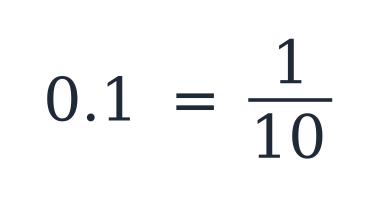
The is on the hundredths place, which means that we need 100 of them to get a whole:
It continues like that. The is on the thousandths place, then come ten-thousandths, and so on, each place ten times smaller than the one before it. So is 9 wholes, 1 tenth, 2 hundredths, 3 thousandths, 4 ten-thousandths, 5 hundred-thousandths and 6 millionths.
The places are not the same size
When we work with decimals, it's important that we don't mix the parts up with each other. That means we mustn't mix tenths with hundredths, and so on, because a tenth and a hundredth don't mean the same thing. A tenth is ten times bigger than a hundredth.
The parts are connected, though. Ten hundredths are the same as one tenth:
That is why, when there are more parts than there is room for on a place, we move over to the next place. You can see that happen in how to add decimals.
Two more numbers, read out
Take . Here we have 1 whole, 2 tenths, 3 hundredths and 4 thousandths.
Take . Here we have 2 wholes, 5 tenths, 4 hundredths and 2 thousandths.
Once you can read a number out like that, adding two decimals is just adding wholes to wholes, tenths to tenths, and so on:
Common mistakes
- "The digits after the point are just a number, ." They aren't one number. Each digit sits on its own place, and each place is a different part of a whole. The is a tenth, the is two hundredths, and so on.
- "A tenth and a hundredth are more or less the same." They're not. You need 10 tenths to make a whole, but 100 hundredths. Mixing them up is the most common way decimal sums go wrong.
Related
The overview of what a decimal is sits in What are decimals?. Adding decimals, including what happens when a place overflows, is in how to add decimals. And the connection between decimal places and fractions, like , is in fractions, decimals and percentages.
Frequently asked questions
Read next
Want to get good at maths?
Mathara explains every topic step by step with videos, exercises and personal feedback.
👉 Get started for free