Guide
Exponential growth and decay
Something that grows or falls by the same percentage every step is exponential. Find the start value, turn the percentage into the growth factor a = 1 + r, and raise it to the number of steps. Worked through with money in the bank, bacteria that double, and a value that falls.
Exponential growth is what you have when something grows by the same percentage every step: money in a bank earning interest, or bacteria that double every hour. We describe it with the equation , where . The usual hurdle is turning the percentage into the growth factor correctly.
When do I use this?
When you meet tasks with a percentage rise or fall of one kind or another, it's a good idea to think exponential growth. That could be the example with interest in the bank, or maybe bacteria that double, so bacteria becoming twice as many per hour or per day. GCSE calls these growth and decay problems, and compound interest is the classic one. The equation itself, and what and mean, is explained in exponential functions.
The procedure
We build the equation from the information in the question, then put in the number of steps.
- Find the start value . That's the amount you start with, before any growth or fall. It's where the graph crosses the y-axis.
- Turn the percentage into the growth factor . The growth factor is , where is the percentage as a decimal. We add because we're putting the percentage rise or fall on top of the we already have. A rise of gives . A fall is a negative : a fall of gives .
- Write the equation. , where counts the steps: years, hours, days, whatever the percentage is per.
- Put in the number of steps. Work out first, then multiply by .
Worked examples
Money in the bank (growth)
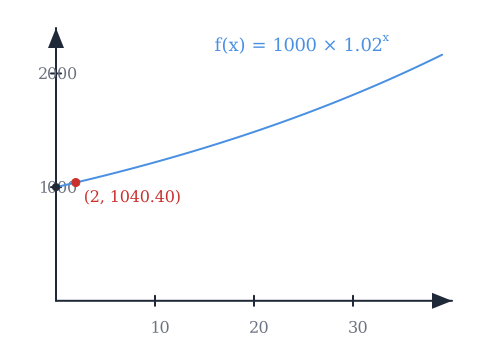
Let's say you start with £ in the bank, and the bank gives you interest a year, so every year you get added on top. The start value is £ and , so
Here is the number of years, because you get per year. To find out how much is in the account after years, we put in for :
So after years at interest there's £ in the account.
Bacteria that double (growth)
Say a dish starts with bacteria and the number doubles every hour. Doubling is a rise of , so and the growth factor is . With a start value of :
After hours:
A value that falls (decay)
Now something that falls by a percentage. Say a value of £ falls by a year. A fall of means , so the growth factor is , and
After year that's , which is just the usual "take off" from percentage increase and decrease. After years:
So after years the value is £. Notice that is still a positive number. It's below , and that's what makes the function fall instead of grow. The graph is the red, falling curve in the exponential functions glossary.
Common mistakes
- Using the percentage itself as the growth factor. growth is , not . The is the you already had, and the is what gets added on top.
- Making negative for a fall. A fall of gives , which is positive but below . The growth factor is always greater than .
- Forgetting that the percentage applies every step. Each year's is added on top of the new, bigger amount. That's why sits in the index: means multiplied by itself times.
Related
Frequently asked questions
Read next
Want to get good at maths?
Mathara explains every topic step by step with videos, exercises and personal feedback.
👉 Get started for free