Maths dictionary
The gradient of a curve: average and instantaneous rate of change
On a straight line the gradient is the same everywhere. On a curve it changes from point to point. The gradient formula between two points gives the average rate of change, and the gradient of a tangent gives the rate of change at one instant, like the needle on a speedometer.
Rates of change is one of those topics many students find hard to get a proper grip on, because it can feel a bit different. The maths gets a bit more abstract here, not as concrete as we've been used to. In short, it's about how fast functions grow. More precisely, we look at how fast a function grows at one particular instant. That can be hard to picture, so let's take an example.
The car and the speedometer
Say we're out driving on the motorway and want to know how fast we're going right now. Then of course we just look down at the speedometer and see that it says km/h. But how would we work it out ourselves? Normally, when we find a speed, we take how far we've driven and divide it by how long it took us.
Say we've driven metres between two points in time, which we could call and , and we know how long it took to drive those metres. Let's say it took seconds. How fast did we go? Well, we drove metres in seconds. That would be m/s, or km/h.
There's a formula we use when we need to find a speed:
It says that we find the speed by dividing the difference between two places (the difference in distance) by the difference between two points in time (the difference in time). If you look at the formula, it also makes sense with the unit for speed: distance measured in kilometres divided by time measured in hours gives km/h.
Here we found the speed between two points. But when we look at the speedometer, we see the speed we're doing right at this instant. There's no difference between two points, because we're only looking at one point, one instant. So there's no difference in distance and no difference in time. Can that even work? Then we'd get:
That can't be right. That problem is what the rest of this article builds up to, and the answer turns out to be the gradient of a tangent.
Average rate of change: the gradient between two points
To really understand this, we have to look at the gradient formula again and see what it actually tells us:
When we use the formula, we can find the gradient of a straight line. But what we actually find with the formula is how fast the function grows on average between those two points. With linear functions we're just lucky that this average growth rate is the same over the whole line, because we're dealing with a straight line. So no matter which two points we pick on a straight line, we'll always get the same gradient.
But what if we have a function that isn't straight? What if we try to use the formula on a function that isn't linear? What happens then? Let's take an example.
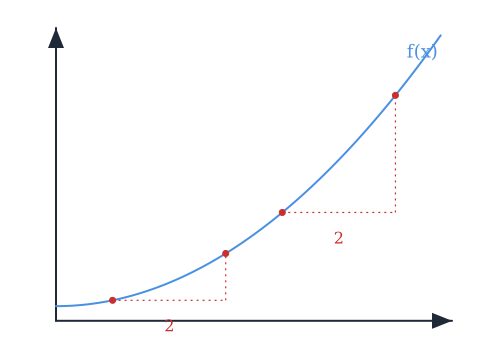
Here we can see that the function grows at different speeds at different places on the graph. Further down, the function doesn't grow nearly as steeply as it does further up. If we go along the x-axis at two different places on the graph, we can see that we don't get the same growth up the y-axis. So there isn't one constant growth rate across the whole graph.
So what happens if we use the gradient formula on this function between two points? What we get is actually the gradient of the straight line between the two points.
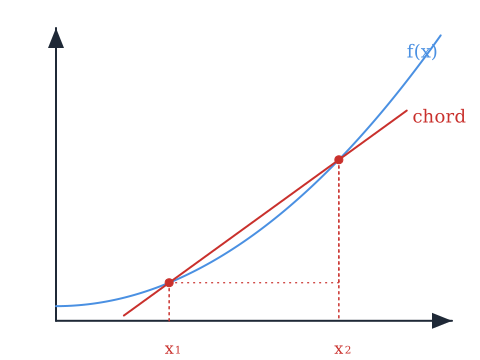
What the gradient of that straight line tells us something about is how fast the function grows on average between the two points. We can see that between the two points the function doesn't grow evenly. But what the gradient formula shows us is how fast the function grows on average between the two points.
This kind of line, which goes through two points on the curve, is called a chord (in my Danish notes it's called a secant), and its gradient, which shows the average growth rate between the two points, is the gradient of the chord.
So it's important to understand that when we use the gradient formula on any function at all, we find out how fast the function grows on average between the two points. With linear functions we're just lucky that they grow equally fast over the whole graph, so the average growth rate is the same as the gradient of the line.
Instantaneous rate of change: the gradient of a tangent
Think back to the example with the car and the speedometer, and the problem we had when we tried to find the speed at one instant and not over a stretch of time. Here we see that the gradient formula suddenly stops making sense. When we try to find out how fast a function grows at one single point, and not between two points, it suddenly gets a bit hard.
When we use the gradient formula on some function, we find out how fast the function grows on average between two points. That's what the gradient of the chord is. Now imagine you have to find the gradient of a line that only goes through one point. That gradient would describe how fast the function grows exactly at that point. In the car example, we'd be working out how fast we're driving at that very instant. We'd be reading the speedometer.
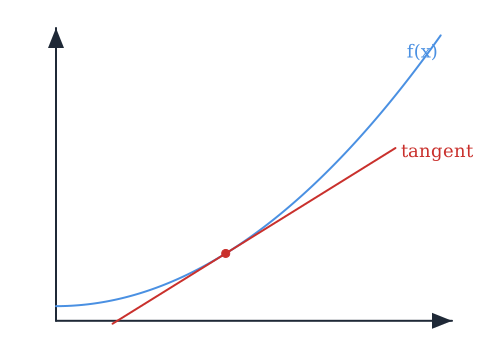
A line that only goes through one point on the curve is called a tangent. Our goal is to describe how fast a function grows at one particular point, so we need to find the gradient of this tangent: the tangent gradient.
From chord to tangent
Right now we only have the gradient of the chord. What we do to get from the chord to the tangent is to move the second point closer to the first one.
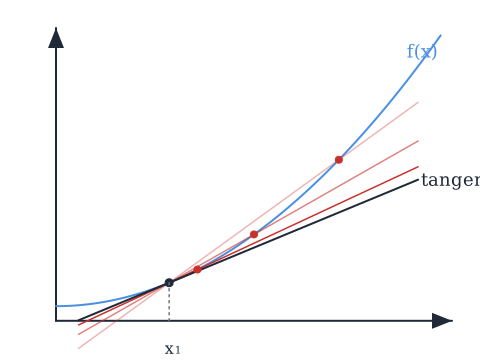
We can see that the closer the outer point gets to the first point, the more the chord starts to look like a tangent. Pushing the second point all the way onto the first is exactly the problem from the car, and getting round that properly is A level maths. At GCSE we use the picture: a tangent is a straight line, so once we have it drawn at the point, its gradient is found the way we find the gradient of any straight line. Pick two points on the tangent and use the gradient formula, exactly as in finding the equation of a straight line from two points. That number is the instantaneous rate of change at the point.
On a distance-time graph
The car example is really a distance-time graph: distance up the y-axis, time along the x-axis. The formula is the gradient formula with distance and time in place of and . So the gradient of a chord between two points on the graph is the average speed over that stretch of the journey ( metres in seconds gives m/s), and the gradient of the tangent at a point is the speed at that very instant, the number on the speedometer.
Common misunderstandings
- "The gradient formula gives the gradient at a point." It gives the gradient between two points, which is the average rate of change over that stretch. Only on a straight line is that the same everywhere.
- " is just , or just ." It isn't a number at all, which is exactly why the speed at one instant needs a new idea, the tangent, instead of the formula.
- "A curve has one gradient." A curve has a different gradient at every point. Going along at two different places gives two different rises.
Related
Frequently asked questions
Read next
Want to get good at maths?
Mathara explains every topic step by step with videos, exercises and personal feedback.
👉 Get started for free