Guide
Double inequalities
A double inequality has two inequality signs in it. We pretend it's two inequalities, solve them one at a time, and put the results back together into one answer: a range of values for x.
Double inequalities are when we have two inequality signs in one inequality. We solve them by pretending we have two inequalities, one for each sign, and doing them one at a time. The hurdle is just remembering that whatever sits in the middle belongs to both halves.
When do I use this?
When two things have to be true about x at the same time. It could look like this:
Each half is an ordinary inequality, so the moves are the ones from how to solve linear inequalities. Double inequalities also turn up when we want to say that an x-value has to stay within certain limits, which we come back to at the end.
The procedure
When we solve one of these double inequalities, we actually pretend that we have 2 inequalities. We split it into 2. Whatever stands between the two inequality signs goes into both inequalities. In the book the middle part, , has a box around it, and the two halves are written underneath in red and blue:
1. Solve the first one (the red one).
We move the x's over to the left side and the numbers over to the right side
we divide by 2 on both sides
Here x has to be greater than .
2. Now solve the other one (the blue one).
We move the x's over to the right side and the numbers over to the left side
now we divide by 3
Here x has to be less than .
3. Put the two results together. Now that we've solved the two inequalities, we can combine the two results
x has to be less than , but at the same time greater than . So: only the numbers between and are solutions.
Double inequalities on a graph
Often, when we only look at a small part of a function, we can actually use double inequalities to mark the interval. We can write, for example, that the x-value has to be greater than 2 but less than 7:
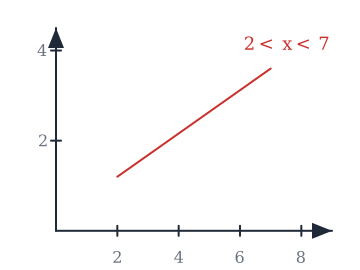
Here we can see how we've made an interval that some function has to follow, with a double inequality. We can see that the function has no x-values less than 2, or greater than 7. We often use double inequalities when the x-value has to keep within certain limits. The idea of a function and its graph is in what is a function?.
Worked example
Solve .
Split into two, with in both:
Red: . Subtract and subtract 7 on both sides: . Divide by 2: .
Blue: . Subtract and add 2 on both sides: . Divide by 3: .
Together:
We can check this is right, because we know a number in the middle should satisfy both halves. Take : the red one gives , which holds, and the blue one gives , which also holds.
Common mistakes
- "Treating it as a completely new kind of problem." It's not. A double inequality is two inequalities stapled together. Split it, solve each, combine.
- "Forgetting that the middle goes into both halves." Whatever stands between the two signs, here , has to appear in both inequalities. Leave it out of one, and that half is a different inequality.
- "Forgetting the sign rule." Each half is solved like any inequality, so the one rule still applies: multiply or divide by a negative number, and that half's sign turns round.
- "Thinking the answer is one number." is a range: every number between and .
Related
The signs and the sign rule are in what is an inequality?, and the single-inequality walkthrough is how to solve linear inequalities. Marking an interval on a graph builds on what is a function?.
Frequently asked questions
Read next
Want to get good at maths?
Mathara explains every topic step by step with videos, exercises and personal feedback.
👉 Get started for free