Guide
How to solve linear inequalities
We solve an inequality the same way we solve an equation: do the opposite on both sides until x stands alone. 5x + 6 > 2x + 7 becomes x > 1/3. The only new rule is that the sign flips when we multiply or divide by a negative number.
When we solve inequalities we do it, as said, just like when we solve equations, but we have to watch out for one small difference. When we multiply or divide by a negative number on both sides, the sign turns round. If it was a greater-than, it becomes a less-than, and the other way round. That's the whole hurdle. Everything else you already know.
When do I use this?
Whenever you have an inequality with an x in it and you want to know which values of x make it true. The answer won't be a single number, like it is for an equation, but a range of numbers. Apart from that, the moves are the ones from how to solve linear equations: do the opposite on both sides until x stands alone.
The procedure
Let's look at this inequality:
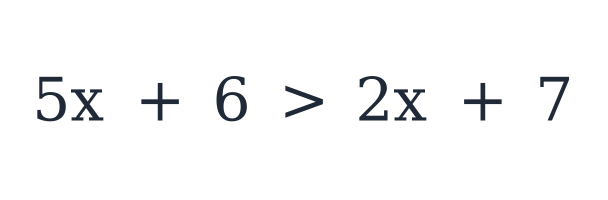
1. Get the x's on one side. We start by subtracting on both sides.
2. Get the numbers on the other side. Now we subtract 6 on both sides,
3. Get x on its own. And finally we divide by 3 on both sides:
and we end up with x having to be greater than .
4. Read the answer. That x has to be greater than just means that every value from , where itself isn't included, up to an infinitely large number is a solution to this inequality. Notice that is not included, because x has to be greater than . If was allowed to be a solution too, it would have said instead of .
So, as we see, it's exactly like solving equations. But we just have to remember the rule that if we multiply or divide by a negative number, we have to flip the inequality sign.
The one rule to remember
Nothing happened to the sign in the example above, because we only ever subtracted, and divided by a positive number. The sign flips in one situation only: when we multiply or divide both sides by a negative number.
Here is the rule applied. If we had
and divided by on both sides, we'd be dividing by a negative number, so the greater-than turns into a less-than:
Adding and subtracting never flips the sign, and neither does multiplying or dividing by a positive number.
Worked examples
No flip needed. Solve .
Subtract on both sides: . Subtract 6 on both sides: . Divide by 3 on both sides: .
Every value bigger than is a solution, and itself is not.
With the flip. Solve .
Divide by on both sides. We're dividing by a negative number, so the sign turns round: .
We can check this is right, because we know that any number less than should work. Try : , and holds. Try a number on the wrong side, : , and 0 is not greater than 4, so 0 is not a solution. So the flipped sign was right.
Common mistakes
- "Forgetting to flip the sign." If you divide both sides by a negative number and leave the sign as it was, the answer points the wrong way. Multiply or divide by a negative, and the sign turns round.
- "Flipping the sign when you subtract." Subtracting, adding, and dividing by a positive number never touch the sign. Only a negative multiplier or divisor does.
- "Treating as ." does not include . It would take a for that.
- "Expecting one number as the answer." The solution is a whole range: everything from upwards.
Related
The four signs and the idea behind inequalities are in what is an inequality?. When there are two inequality signs at once, see double inequalities. The solving moves themselves come from how to solve linear equations.
Frequently asked questions
Read next
Want to get good at maths?
Mathara explains every topic step by step with videos, exercises and personal feedback.
👉 Get started for free