Guide
Inverse proportion
Inverse proportion has the form y = k/x: when x goes up, y comes down. Here is what that means, the other forms it can take, and how to find k from a running example.
Inverse proportion is also a relationship between two variables, like direct proportion. But it comes in a different form. This guide shows the form, the other ways it can be written, and how to find the constant from a running example. The relationship can sound a bit advanced, but it is actually fairly easy to understand once you have seen the example.
When do I use this?
When one quantity goes down as the other goes up, in the very particular way where the two multiplied together always give the same number, like speed and time for a fixed distance. In exam questions it shows up as " is inversely proportional to ".
The form y = k/x
Inverse proportion comes in the form
It can also come in other forms, if we just rewrite the original form. That could be
Remember, these are just rewrites. We have only moved things around in the original form, the same thing we do in equations when we get on its own. Written in that last form, it has exactly the shape of direct proportion, times something, only the something is instead of . That is why you will sometimes hear that is proportional to .
Worked example: running at different speeds
If we are out running at 8 km/h and we have to run 8 km, it takes an hour, because we run 8 km in 1 hour. If we now ran twice as fast, 16 km/h, it would only take us half an hour. Here we would say that the time it takes us is inversely proportional to the speed.
We can write it in the mathematical form, since we have found that the time we spend is inversely proportional to the speed:
Finding k
But what is ? If we use one of the other forms, namely , we can find , because we have the time it takes and the speed, that is, both and :
If we look at the units, we are dividing by hours and multiplying by hours, so they cancel each other out. That gives us , so we have found the constant of proportionality to be 8 km. We can therefore write
We can check the half hour: at 16 km/h we get hours, which is exactly the half hour we said.
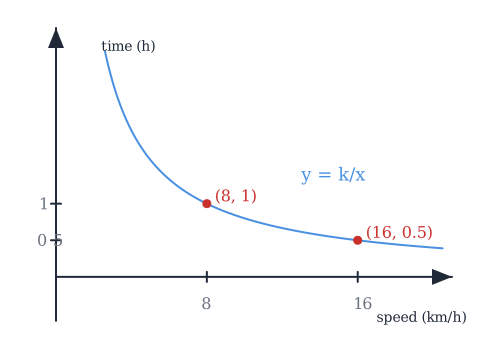
Here we saw that when our speed goes up, the time we spend goes down, so inverse proportion is used to describe situations where exactly that happens.
Common mistakes
- "Inverse proportion just means y goes down when x goes up." That is a consequence, not the definition. The defining thing is that stays constant. Twice the speed gives half the time, not just "less" time.
- "I can't find k without being given a formula." Any pair of matching values will do. Put them into , as we did with 8 km/h and 1 hour.
- "y = k/x and xy = k are different rules." They are the same rule, rewritten. Use to find , and to find afterwards.
Related
- Back to the pillar: what is proportion?
- The other kind: direct proportion, where is constant instead.
- Rewriting as is the same move as rearranging an equation.
Frequently asked questions
Read next
Want to get good at maths?
Mathara explains every topic step by step with videos, exercises and personal feedback.
👉 Get started for free